Friday, February 3, 2012

The 2012 Atlantic Salmon Season

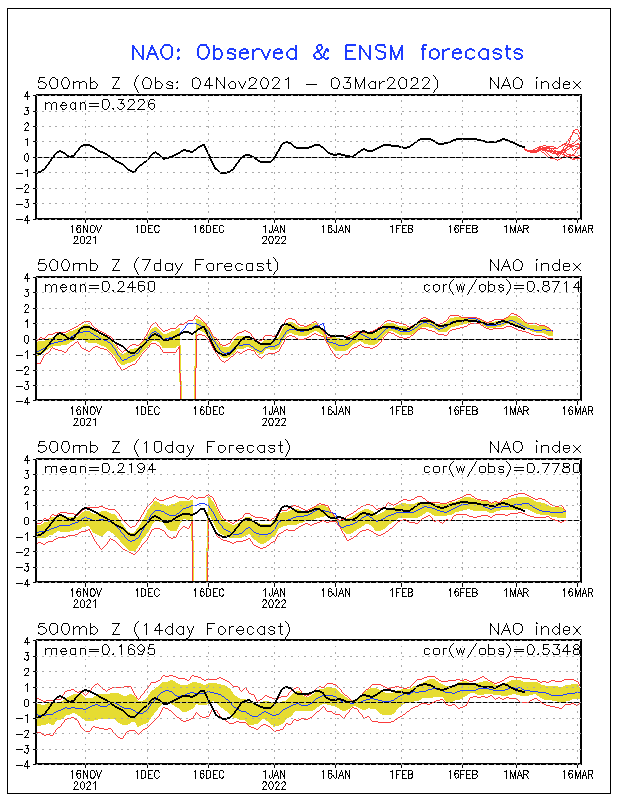
Click Graph For Latest Results
Here in the North East United States, so far, we have had one of the mildest and storm free winters on record.  If you look at the graph above it holds the reasons and understanding of why this happens.  In prior posts, I have explained the North Atlantic Oscillation and it's effects on Atlantic Salmon returns in North America.

Simply, the NAO has been in a positive, northerly position,  state for this entire season starting back in October.  Also note that the red line forecasts show a possibility that we will be in a negative position very soon. If the temperature in the North East gets colder you will know why.

You may have seen on the news the extra cold temperatures that have been locked in the Arctic.  Because the boundary between high and low barometric pressure in the North Atlantic has been pushed so far north, the cold is blocked and can not move south.  Conversely, the warm is able to travel farther north carrying the storms and warmer air in the elevated jet stream across Southern Canada.  This would usually mean greater snow fall in Quebec and the Eastern Providences.

What this also means is that those storms traveling across North America are moving into the Atlantic Ocean at a higher latitude disrupting the winter feeding areas that Atlantic Salmon require to sustain numbers and size.  Food is scattered and harder to find.   It also means that these storms will travel farther north in the Atlantic and circle down into Europe causing lower than normal temperatures and substantial snowfall.  The normal path would have these storms joining with the effects of the Gulf Stream and offering Europe a typically mild winter.  Given the news reports I have seen, sadly Europe is having a less than typical and deadly winter.

As hard as it is to make any prediction,  and if I were only using the information so far, and except for one factor, the writing would be on the wall.  I would say we are going to certainly have a down turn from last year.  Not a bad season because of the fairly even line on the graph.  Years past have had the spikes be car  more dramatic in both directions.  If the graph were to turn negative and stay that way for the balane of the winter I might have a different opinion.

This year, the X factor is that there have not been so many harsh storms that have moved across Newfoundland and north to Greenland.  I have been told by a highly reliable source in Newfoundland that things are close to average with a bit more snow on the eastern part of the Provence.

This factor could negate the effects of the oscillation alone.  If the ocean is not tormented then predator will find it's prey comfortably.

So as the season progresses into summer, remember that the Oscillation is in an upward swing of it's thirty five year cycle.  Just like the banner year of 1996 during the doldrums happened, 2012 might not go down in history as very special.  But then again..........

So, now that I have said this, it is a wait and see for me.  This is year number four trying to understand Earth science from an anglers point of view.  Also it is very early in the winter season to conclude any prediction.  I plan to closely follow the NAO for the next three months as conditions could change.  I know that I  need many more years of full season information to completely understand all the effects that are possible.

William

Monday, January 30, 2012

Love The Colors This Time Of Year

There is something about the cold of winter that brings out all the colors on the rainbows.  The shimmer of their cheeks and the exclamation of spots has the ability to keep me warm forgetting the wind for a moment.  The water over the weekend was 32.5 degrees and the fish were taking stripped and swinging flies.  You just never know........

Saturday, January 14, 2012

I Went Fishing Yesterday

Looking at the Weather Channel, about the cold front rolling across the Mid West, made the decision to be outside yesterday a bit of a gamble. The report listed winds between 20 and 30 miles per hour, a combination of sleet, snow and rain, with plummeting temperatures as the day progressed.

Sounds perfect, and I went fishing.

The new snow, that fell the day before, made for a truly beautiful winter environment.  Arriving later than usual, I geared up and made my way to my favorite pool.  Within four casts I had an eighteen inch rainbow with cheeks of crimson and fins as translucent as can be.  Just a wonderful example of New England at her best.  A nice part of catching this fish is because a new fly that I created did the trick.  Half Feedinator and half Jailbird with a rib of burned Peacock Eye.

For the next three hours I worked the entire run from top to bottom with every fly I could think might work.  The weather meandered between sleet to snow and surprisingly I was warm and comfortable .  No wind yet, as the front had not run through and temperatures were staying in the mid thirties.  I just kept thinking how perfect it was and only if the fish were feeling the love.

Knowing that my time was short, due to a commitment back home, I decided to call it a day.  Well, almost.  I made a short drive to one other small pool.  No footprints in the snow and why not throw a few casts.  In the next hour the heavens opened to bright sunshine, the wind started to make some noise and I could feel the temperature making a steady decline.  The other thing that happened was I hooked five rainbows, the largest was twenty four inches and the smallest was twenty and one salmon of nineteen.  This small untouched pool had so many fish it was just amazing.  This was a real steak and eggs event with the two flies that took all the fish being an orange red dot egg and a micro San Juan Worm.  The fish were taking the fly at the end of the swing and feeling the take was hard and vibrant.  These were aggressive fish even though the water was in the mid thirties.

I had to leave.  I didn't want to leave, but I had to get going.

This morning, as I tell you about this story, the front has passed, the temperature will be minus digits by tonight and winter will be holding the North Country captive for a few days.  I'm looking for a moral to the story or a some reason that I could be so lucky.  Let's just say I will be looking forward to the next Friday the Thirteenth.

William

Thursday, December 29, 2011

In The Spirit Of Winter Angling

New Year's Day is often shrouded in a blanket of deep snow here in New England.  Arriving at the river early usually means frozen guides and enough layers of clothing to make mobility a bit harder than usual.  The only things that will stop me from being out, this hallowed season opener, will be single digit temperatures or very dangerous driving conditions.  It's looking pretty good on both counts right now with clear skies and temperatures in the mid to upper thirties..

This is a day that can be very special and seems to be gaining interest, as my email has been active with inquiries from friends wanting to be out and on the water.   January 1 is imprinted in my being and is not one I want to miss.

Today, I had the dog out back for a walk and it is the first time this year the trees were cracking in a stiff wind.  The pond down the street should be solid with skaters playing hockey but is still open water.  I keep thinking that the law of averages is going to be demanded and January is going to be hard to take.  The North Atlantic Oscillation is telling me the colder temps should hold off for a few days at least.

For now, I am in front of a fire reflecting on one of the finest angling years of my life and looking forward to Sunday to get it started again.  My fly box has been readied for a month now with a great winter selection of proven winners.  The high water of early December has leveled to a perfect flow and the snow cover starting to accumulate in the North Country will keep levels safe.

There are many great places to fish during winter.  So many avid anglers don't take part in the off season and are missing some great fun.  Think about the possibilities near you.  Is there a post spawn Brown Trout river with a dam above the area you fish.  How about a lake with a dam that releases water to meet winter levels and harbors Landlocked Salmon and trout that might emigrate.  Good places to swing a Black Ghost for sure.  Think about where the fish would be during the middle of winter and you just might find a rainbow.........I'm just saying...........

Wishing you a safe and wonderful New Year with many adventures and a few big fish......

William

Tuesday, December 13, 2011

The Joy Of Tube Flies

In my opinion, tube flies are just plain fun. I don't need any other reason to tie them and try them. I will do my best to offer the pro's and con's.

Pro's

A tube fly, based on material, length and shape can be both lighter or heavier than flies tied on hooks.

A tube fly can be much longer with the hook in the back of the fly without creating damaging leverage.

The hook size of a tube fly can be changed according to situation and fish species.

You can make plastic tube flies hitch or skitter for salmon.

A tube fly will accept cone heads, bead chain and baffles with ease directly on the tube as you are tying.

Con's

Sorry, I can't think of any.

There are many different size and weight of tubes available on the commercial market. The range of fly structure is substantial. From straight style ranging in plastic to tungsten, from H.M.H., to the various shapes of metal from Eumer and ProTube, to all the different bottle tubes made in Europe. Your choices are endless.

Here is a tube within a tube constructed Scandinavian style fly that I would use for salmon on heavy rivers as well as Steelhead everywhere.

The reason for using tubes on long flies is the most important positive characteristic to me. Take a Carrie Stevens style streamer for example. These well noted and documented gems of New England lore and crafted on special long hooks were made this way so that the point is at the back of the streamer. The leverage from line to hook point caused by the long shank of these hooks is very damaging when the fish is thrashing about. A tube fly separates from the hook and causes less damage toward a live release practice. Also you will land more fish, should you like the table fare, because the leverage does not rip out the hook.

Tube flies will get weight added as you are tying the fly. Stacking cones with a palmared hackel between each is possible. With hooks you must apply the weight first and then tie toward the weight.

A tube fly is made with a small diameter connecting tube that holds the hook in place. This allows for quick change of a tail that can have different materials and colors for accent to the fly. Adding that little plume of red marabou with a bit of crystal flash just might be the ticket.

Hitching for salmon in summer is as simple as drilling holes at the side of the head and threading your leader through the hole.

I have now tied many tubes over the last ten years for Atlantic Salmon and am working on steelhead patterns to swing with an 8 weight switch rod. I will give you an up date as soon as I have a few flies to show. Give it a try and let me know what you think.

If you want to know more about tube flies please e-mail me a flyspoke@gmail.com

Tuesday, December 6, 2011

Fly Tying Tip #124

I find it very hard to be purchasing my tying materials on line.  Standard items like brand name hooks and a number of synthetics that I know well are not the issue.  Fur, feathers and the vast array of new items becomes a factor.   A smarter way, be it more time consuming, is to visit your best fly shop and bring the materials with you that you intend for a pattern.  Compare color vibrancy and contrast with the materials you need to purchase to complete the fly.  This will also give you a good idea if the items you purchased in the past are of high enough quality as well.  Size and quality can be worked around but color and dying variation can not.  Inspect the entire inventory at the shop and pick what will be the best.  Ask the shop owner their opinion.  Having that person to talk with is worth the price of admission.

William

Sunday, December 4, 2011

Sometimes At Berry Brook They Are Just An Illusion.........

Each year I spend some time at Berry Brook in Rye, New Hampshire.  This location has the possibility to reward you with a sea run Brown Trout that can be as large as eight pounds.   I always try to fit in a day or two during December to stop and watch the water.  I don't even take the rod from the car unless I see a fish.  The rod has left the car three times over the last fifteen years.

Today was just a beautiful morning with the sun shinning and a constant wisp of high clouds moving from the South West.  From Brackett Street you have a good vantage point by standing on the river right up stream corner of the bridge.  Remember these are large fish you are hunting and the slightest turn will cause the water to move.  I keep my eyes moving from above to below the bridge.  Fifteen minutes moves to an hour and I am now forcing myself to stay.  On the down river side I am doing my best to wait for the tide to start to build with the hope of a fish moving up.  On the up river side I am hoping for a fish that has traveled and is in the deeper holding pool.  I have seen them in both these locations yet the only action has been below the bridge on an in coming tide.

As angling accomplishments go, the illusive Brown Trout of Berry Brook still rank high on my stringer list.  Hooking two and landing none has kept it out of reach.  I'm sure that I will continue to show up a few times a year when the time is right.  Today was just another day spent with an illusion.......

William

Thursday, November 24, 2011

Dark Light Shallow Deep Bright Dull Heavy Light Slow Fast Cold Hot........................................ In Relation To Trout, Salmon and Steelhead

Most of us will fish all day without the slightest consideration of the reasons we fish the fly we do.  "It sure worked yesterday" might be the best rational that we come up with.  Could yesterday have been a perfect match for that fly that was used at the end of the day that offered just the right light in a depth of water with just the right weight to have the fly traveling at the correct speed in the perfect color and contrast that matches the situation?  Take a deep breath..........

Each and every angling day can be broken into very small segments where perfect may only happen but a few times.  My contention is that the more we are willing to have those perfect moments the greater the possibility for a connection.

Dark Light
Each complete fishing day consists of the same start to finish.  It's like the "Hippy Dippy Weatherman" routine of the late comedian George Carlin.  "Darkness will turn to light and later in the day it will get dark again".  Given the fact that a Salmonoid has the ability to see white and black in total darkness and blue as the first and last other color you can have a good opening and closing just by utilizing this information.  There are 24 different hues that will be available through the day.  With the highest visible color being blue followed by reds and orange and concluding in green you will have a basis of choice.  By also taking into consideration the use of these colors as fluorescence you can enhance what a fish can see by changing the spectrum waves and how they pass through and are absorbed by the clarity or increase in tannin in the water.  Every water body has a different clarity.
Shallow Deep
During your day you will encounter water at different depths.  Because water has the natural ability to absorb and defuse light, the amount of light will be determined by the depth that it can penetrate the location you are fishing.
Bright Dull
Bright sunshine offers us the greatest array of colors the fish can see.  This is when the end range spectrum can be effective.  Contrast has the greatest effect.  When the day is dull the available colors that will be seen are more in the dawn day to dusk cycle.  A bit of flash can be just what is needed to be noticed.
Heavy Light
Simply said we pick the weights, length of leader, weight of fly and size of fly that matches the moment.
Slow Fast
For me the speed  that my presentation is traveling can have the greatest effect on getting a reaction.  I want my fly moving at the speed the fish want and seeking this piece to the puzzle can be the most difficult of all.  Moving at the speed of the water is a good place to start.
Cold Hot
Take the temperature of the water when you arrive.  Take it again each hour.  If you have a warming trend, even in a quarter of a degree increments you can know that the fish will make short movement to your fly.  Remember that on days that are sunny with snow on the ground the rising air temperatures can cause the water to get colder.  The other end of the range into very warm conditions will also limit the activity of our quarry.  They will seek cooler and shadier locations to spend the day with lower light availability.

Conclusion
In all of the above you will find the basic pieces toward seeking the goal.  Give some thought during a day on the water to these physical characteristics might be beneficial.  The one constant is contrast.  Do we put a red dot on a chartreuse egg because it looks like blood?  Or is it the contrast that enables the chartreuse so visible from the background?   There is little contrast between red and orange and a great difference between pink and black.  Enhancing the go to color with a strong second choice is a very important factor.  Incorporating the properties of iridescence, as can be seen in peacock hurl and many synthetics will also give added sparkle.   What puzzle lies before us can be analyzed and what can be analyzed may be answered and what can be answered makes us better anglers.  

William


Monday, November 14, 2011

The Copper Cap

This was yesterday's hot fly for fishing for Rainbows.  I fished it dead drift nympy style with 6x on a medium sink 7 foot PolyLeader.  I found it to work best in the faster water.  You can also change color of the body and head to black, brown, tan or olive.
Hook-Any Curved 18-22
Body-Red 70 Denier Thread
Rib-7X Clear Mono
Thorax-Brown SLF With Copper Accent
Wing Case-Copper Mylar
Head-Red 70 Denier 

Thursday, November 10, 2011

Getting To The Bottom Of It With Poly Leaders

This past week I traveled to a beautiful  river in New York State.  The regulations on this river are that no added weight, indicators or weighted flies are legal.  You may use sinking line so long as it is not a lead core type.  This is heaven for the two hand caster and I plan to return as much as possible.

The fishing is done mostly by swinging flies with single hand, switch and two hand rods between 9' and 12'6".  Six seems to be the go to weight.  In order to have the correct presentation you must vary the depth and speed of your fly according to river flow and depth of pool.  The fish will take swung flies but you must  get them down toward the bottom a bit.

The Salmon range from a few to twelve pounds.  There are also Steelhead and large Brown Trout available so the opportunities are as wide a range as the flies in your pocket.  The best flies we found for swinging had somber Bronze Malard wings with gold bodies.  I'm sure that under different conditions it would be something else.

Having the correct depth was made easy with the incorporation of using PolyLeaders connected loop to loop at the end of a modified switch style line.  I think the closet thing that is commercially available would be the Royal Wulff Ambush line.  A short head line that will make crisp yet decent length casts while standing close to the bank and under trees and bush.  In shallow locations, a hover poly could be used, and in deeper faster runs changing to a 6.1ips sinking and longer poly could be changed over in a matter of a few minutes.   Just keep the tippet on as you change and you are all set.  The other variable will be the length of your tippet.  Typically I ran the tippet at about three feet.  If I wanted to ride a little higher, I just added another foot or so with a Double Surgeon's Knot.

This is a great system that turned over larger size flies with ease and made overhead, switch and Skagit style casting easy.  They also cast very well with single hand rods and offer an added push of distance and line speed.  The AirFlo company was the first to make these tapered specialized sinking leaders and created them for improved casting accuracy as well as sinking.  I first started using these PolyLeaders while fishing the River Tay in Scotland about eight years ago.  No one fished without one.  They were not in any store that I could find in the States at that time.  Now every major line company and fly shop has a well stocked supply.

Another application and reason to carry PolyLeaders would be for the angler who wants to make sure that all bases are covered when nymph fishing.  As you have your fly line ended with a small loop you can high stick with or without an indicator and weight and then change over to a poly in a very fast time.  I often fish one set up at the top of a pool a different rig for the deeper middle and am willing to change for the tail out.  It is always optimal in only one perfect style at that moment and the challenge is to get it right as much as possible.

There are some anglers who confuse these new style leaders with sinking heads that are clunky and do not cast well on single handed rods.  They will get you down to the bottom when made from T-7 to T-14 and should be used as a line extension and not a leader.  Longer length tapered mono leaders or knotted tapered leaders should be attached to the end of these sections.  I use them as cheaters with Skagit lines when I need to go down deep and fast.  Cheaters are used to make sure that the length of your fly line head is always the same so your casting stroke can be constant.  But that's a topic to itself and for another time.

Weather you are a nymph fisher with weights and indicators or a swinger of streamers you can make your set up do both with the same rod, reel, spool and line by the use of PolyLeaders.  This is very inexpensive to give a try and will add an extra piece to the puzzle.

William


Wednesday, November 2, 2011

Fly Tying Tip #123

I have a fond appreciation for tying Atlantic Salmon flies for fishing or for fun.  One thing that is present on most is the symmetrical look that an up curved tail will give.  The idea is that you will have the tip of the tail touch the tip of the topping.  The easiest way to do this is to pre select the tail and the topping and soak them in warm water.  Then have a collection of bottles in different diameters to lay the feathers on and let them dry.  Make sure they will match by holding the feather on the bare hook.  Lay in the tail and crimp bend the topping exactly where it must sit at the head of the fly.

Saturday, October 29, 2011

Big Fish Eat Tiny Meals - Midge Fly Time Is Here

Last winter I made a decision to get very tiny with my presentations for late fall and winter.  By tiny, I mean using flies size 20 and smaller.  Because there are over 700 different non biting midge flies in North America, finding the best colors is going to be a trial and catch situation.

In addition to the simple larval form of the life cycle you will want to tie very small versions of flies like Pheasant Tails, Hairs Ear, Copper Johns and various Chironomid imatations.

During our regular season from spring to fall these tiny midges will go through a complete life cycle from egg to adult in a 2-3 week period.  This is why very tiny flies are all that fish will eat at certain times.  When I find myself in a situation where I know the fish are eating, and I can't get a hook up, I will get smaller and smaller in my selection and hope that size 22 and below will not be necessary.  You will have this happen more often in tail water locations.

At the end of the season the complete cycle will stop and suspend in the larval state through the winter.  November will start as the smallest and April the same pattern will have grown a bit.  I have been fishing for Land Locked Salmon at the end our New Hampshire season, and a very successful fly is the Olive Jailbird by Marla Blair in sizes 18 and 20.  I tie them from light to dark in color with dubbing as well as a very thin version with thread for the body.  Finding the red wire for the rib in a small enough size is a key element.

Because there are so many different possibilities for these flies, When trout and salmon fishing, I carry at lease 100 with me me at all times.  I build them in olive from light to dark, copper bodies with different dubbing for the heads, red from bright to blood, green from pale to dark, brown from tan to mahogany, with and without beads, with or without weight, with or without ribs, with or without flash and many different hook shapes as are made.  Over time I expect that I will keep track and learn what works best on the rivers I fish on a regular basis.

I have found that using a larger fly with a bit of weight and the midge as a dropper has been working the best.  Because of the size of the eye on these tiny flies I must use a lighter tippet.  For the weighted fly I make the size larger and use a heavier tippet.

23" Salmon #18 Jailbird
Because these insects go through a complete egg to adult cycle you will want to have a few dry flies that will work at times.  Because of the higher water temperatures on tail waters it is possible to have a need for emergers as well as dries.  A size 18 or 20 Griffiths Knat in black, grizzly and brown should work just fine.  I always have a few dries available because you never know when the condition  will be just right.

Don't let the tiny size of these flies intimidate you.  You will get used to the size and a pair of magnifying glasses is a big help.  Big fish eat small meals and at times it is the only thing they want.

William

Thursday, October 13, 2011

Fly Tying Tip #122

Wilde One 
A hook has a natural balance and weighting so that the point rides down.  Many of us are now using nymphing techniques that have flies with weight as well as adding shot to leaders.  Grabbing the bottom and loosing many flies becomes an all day affair.

One thing that we can do when building flies is to top weight so the fly will ride up side down.  At the same time tying the fly up side down will make things look right side up.  By laying one or two strips of weight along the top edge of the hook you can easily throw the hook out of balance and maybe loose a few less flies.

Tuesday, October 11, 2011

The Czech Nymph Style

Picture From The Jersey Angler Blog
Yesterday was a very interesting day, here in New England, for more than one reason.  First it was one of the top ten looking and feeling days of the year.  October can be an unsettled month and the last three days have proven record high temperatures and beautiful sunshine.  Not the best fishing weather but very comfortable to be alive and on the water.

Second, I watched an angler use a three fly Czech Nymph set up who was taking more fish than all the other rods combine. The only thing that was added to a standard Czech set up was a small wool indicator.

This is a very simple concept to understand and at the same time offers the most complete river coverage possible.  First you determine the depth of the water that is close at hand as you will be high sticking with as little line on the water as possible.  Only the indicator would be the best.  The indicator is usually a change in color of the top section of your leader system or a colored sleeve or spring that fits on the line where the leader starts.  Next you tie in three flies using the water depth as the total tippet length.  The middle fly will be a weighted Copper John or Bead Head fly that suits the location and will bounce the bottom.  Then in secession up and down you will put the other flies eight to fifteen inches from the middle fly.  The flies determined by location and condition.  You can also try to put the weighted fly on the bottom.

By the use of Triple Surgeons Knots you can create droppers off the main leader.  The leader is a flat line and all the same pound test.  The bottom fly is on the main line and the others are off droppers.

As you can see, this is not a very typical situation.  The weight is at the middle or bottom.   What I see most anglers doing is putting the weight higher up the leader and bouncing the weight with the flies hanging below.  This style is only fishing close to the bottom while the Czech style is covering three different water colums on every cast.  You can have your Stone Fly in the middle with Pupa below and  an emerger above and cover river bed to top.  This is the opposite concept of using a dry fly with a dropper.

All I can tell you is that this rig was doing the job well and tomorrow I will be giving it a solid effort myself.

William


Wednesday, October 5, 2011

Fly Tying Tip #121


As you are inserting a hook into your vise, never let go of the shank until the bend is firmly in place between the jaws.  I have shot hooks clear across the room when applying final pressure. 

Monday, October 3, 2011

Federation Of Fly Fishers Certified Casting Instructor

As you can read on my Fly Casting Page, I have worked very hard to complete this stage in becoming a quality single hand casting instructor.   This ability and understanding is necessary for me to feel good about who I am and what I am capable to be.  And especially what I can do for other anglers.

I am very proud to report that I have accomplished this beginning goal. This weekend I passed the written as well as performance tests to become a Certified Federation Of Fly Fishers Casting Instructor.

I want to say thank you to Rich Kovars CCI for keeping me on track and giving me the understanding that with a set plan and a dedicated practice schedule it is possible to be a good quality caster with the skills necessary to teach.  I will continue to learn and work to be better because as we know in this wonderful sport there is no limit and no end to what we can share.

William