Tuesday, May 21, 2013

International Federation Of Fly Fishers Certified Two Hand Casting Instructor

For the past three years I have been working toward being certified by The International Federation Of Fly Fishers to become a two hand casting instructor.  Many, many hours of learning and practice with the goal of this achievement have been spent.  Now that I have passed this test, I am left with the feeling that I want more.  Let me explain.

I feel as though I have the responsibility to live up to standards that are still above me.  I was tested by Al Buhr.  How will I ever achieve that standard?  Even though I am now in a group of only thirty others in the United States with this status I am still humbled by the meaning.

While I was on my way to North Carolina, for examination, I received an email from Gordy Hill that Bob Runpf had passed.  I was just with Bob a month ago at the Catskill Fly Fishing Muesum working with Wild Trout Flyrodders.  Bob was casting and I was watching and noticing how fluid and clean he was with the fly rod.  Sadly, I missed his presentation as I was being pre tested for THCI by Jim Valle.  The reason I mention this is because it put reality and the importance of our lives in perspective.  Not only was Bob a great caster but he was a great person with many people who are touched by the loss.

So, for me, I acknowledge that I am on a new path.  Not the end, as I once thought. I am now placed in the position of responsibility to be what I am titled as being.  I promised Al I would live up to the standards required and intend to do just that.

William

Joining the International Federation Of Fly Fishers will offer you a group of anglers who have the passion and desire to learn, teach and share all they know.  I am proud to be a member, Single and two hand instructor and will be so until I make my last cast.

Friday, May 17, 2013

The Saco River And The Dry Fly

The weather can be a mixed bag of what you can always count on in the Saco Valley flowing through North
Conway for Mid June.  The river, with head waters at the foot of Mount Washington has a rugged start and flows through New Hampshire, pushing east in Maine and enters the Atlantic at it's namesake on the coast.  Showers, sun, wind, cold and warm are a possible part of any day.  Each year at this time I make sure that the gin clear waters are in my schedule.  I fish a number of single days and could easily make it a week long destination.

This river has all the ingredients necessary to make it one of the finest quality trout streams in the world except one.  It does not have enough low temperature input to sustain  a large population of trout through the warming summer.  But don't let that stop you from enjoying the magic of the Saco's season.  Just looking at this fly chart supplied by North Country Angler will assure you that the river is a very futile environment.  This well stocked shop has a high level of knowledge and can arrange top notch licensed guide service as well.

I show  up in the morning with the intention to refine a bit of my dry fly skill.  For me, this is the part of the game that holds the most satisfaction as well as necessary ability.  Even though the trout are hatchery raised they will get acclimated and turn fussy quickly.  This is not a river that I have the ability to walk in and hit the correct fly immediately.  This is a river where you make your approach in the Gary LaFontaine way where you sit and observe first.  You must always be watching for change and rest assured that change can happen quickly.

Last year on a Friday morning I started with a fine Brown Trout of seventeen inches or more.  I make it a habit to look into the river to see what is happening.  What I saw were the dead mayflies floating down with clear wings.  You may not make the correct choice every time but at least you have the possibilities.   I learned later that the spinner fall was amazing the evening before. The morning fish can also be fooled with size 16 Adams, Red Quills and Yellow Sally's.  One thing needs to be made clear, this is a tough river at times and what worked yesterday, let alone last year might not today.

On Saturday morning I started where I left off the evening before.  What I had learned condensed my fly choices and proved far more successful.  Working small and making frequent changes was the order of the day.   Blue Wing Olive, Adams, Red Quill, Yellow Sally, Rusty Spinner and Black Woolly Buggers accounted for most of the connections.  The comparadun style worked particularly well followed by parachutes.

As the head lamps came on I hooked my last fish of the day.  I had worked this fish a number of times and interest with rejection was the pattern.  This was a real nice size Brown that was as large as the stocking truck had delivered.  I picked out the smallest Parachute Adams with an orange post that was in my box.  The fish rose and sipped the fly and was solidly hooked.   The charge was instantaneous and quick, directly across the pool  making my reel scream with delight.  And then nothing.

Now, I really don't like leaving hooks in fish.  I am always using larger tippet sizes than many anglers and only when I can not get the tippet into the eye of what is needed will I go smaller.  I find that I am still able to take as many fish as anyone else but I land a far greater percentage.  For whatever reason, my tippet did not hold and ,being content with a long day on the river, I called it an evening.

The Saco is as close to perfect as you can get here in the east.  Some say the kayaks and canoe hatch is a problem but I watch the boats go by and the trout start feeding before the wake has left the water.  They don't schedule drop offs very early or late and leave the best of the day's events from disturbance.  The people do apologize way too much.

Give yourself one full day if you can.  This is a river in the most pleasing of surroundings that should not be missed.

Monday, May 13, 2013

The Balance Of Power Or The Power Of Balance

So I have been practicing about three to four hours a day right now. Today I did a five and a half hour session with a 15 foot 9 Weight Robert Meiser Highlander S. Crazy rod with some of the finest craftsmanship I have ever had the privilege to cast. I lined it with a 9/10 65 foot head Carron Jetstream. The reel is an original Loop Evotec made by Danialson. If you are familiar with those reels you know they were known for how lite they are. Really not a very good Spey reel.

Anyway, I have been working on the physics between balance and power or a class one lever. Kind of like if you had a sea saw out of balance it would take extra power to move the longer side. Less weight having to move a heavier and longer shaft. Each and every two hand rod we own has a different balance point given the weight of reel and line. Take any of your rods, strip off the amount of line that you most often use with that rod and then find the balance point. It might surprise you that it will not be even on the top grip. In my case it was three inches over the top grip today. I thought about how I could balance the rod for my practice and the electrical tape I used to secure the furls came in handy.

Balance each reel with lead core, if you must, to force the fulcrum point to exactly where you want it to be. It should be at the fulcrum or your top hand placement on the rod. Then give the rod a go and you will not believe the power you will generate with such little force.

William

Saturday, May 11, 2013

Catch & Release Is A Learned Art

This Photo has not been altered.  It was taken after dark on
the Matapedia River in Quebec.  There is a 25lb. salmon being
released and never touched.

What started as catch and release is ever evolving. Today we are saying live release. Tomorrow who knows what the correct saying will be. This is a controversy that I will leave for another day.
But what about those seconds or minutes between the catch and the live release that we can learn to control. I find myself standing and watching anglers with good intentions struggle to remove hooks with barbs, hold fish too tightly and have a three minute photo session. Take two please.
I know that there were times when I have been guilty of not being competent or caring enough to dispatch my fish without harm. I have killed one large salmon on purpose and will continue to take a grilse or trout from time to time. There is nothing like a shore lunch with the fish you captured a half hour ago. Say three Our Fathers and three Hail Mary's. Done.
In order to do our best, limit guilt and increase survival, we need to learn the release part of angling because timing means everything to the life of our fish.
Make sure to use a live release net on fish of size. Fish have a protective slime coat that if removed will cause infections. Always wet your hands if you must use them. On smaller fish do not touch the fish at all. This is possible by using barb free hooks. Knowing that my hooks do not have barbs allows me to remove the hook without fear. Hold your fish out of the water for as short a time as possible because the change in weight differential can be very harmful. Do not put a fish down on snow or ice as their skin will freeze. The photo session is the most damaging and critical part of your live release. For a while now I have not been worrying about photos of my fish captured. If I do, I try to make them all part of the process to let the fish go. If the hook is removed and the fish is ready to be released, keep it in the water. Ready, set, lift low, snap, down and gone. You can make this prized photo with one second out of water so long as you and your partner understand the process. Let your photographer use his camera that he knows well and you will get the best results.
The last note is on revival. The old adage of holding a fish by the tail and moving back and forth needs to be put to rest. I still see people do this today. The only revival method you should use is to hold your fish still and straight into the current while supporting their weight. In still water the only movement must be forward holding very lightly. The fish will tell you when it is time to go.
Part of the reason for our live release practice can be summed up best by Lee Wulff. "A fish is too valuable to only be caught once" I agree.

William


Thursday, May 9, 2013

Please Welcome A New Sponsor R.B. Meiser Fly Rods

If you ever have the opportunity to cast the Two Hand and Switch rods made by Robert Meiser you will understand how fine a fishing tool should be.

Tuesday, April 30, 2013

New Hampshire Brood Stock Atlantic Salmon

I have been angling, in New Hampshire, for Brood Stock Atlantic Salmon for many years.  During these seasons I have seen some great days hooking fish, landing a few and have learned a number of successful ways to get them to take a fly. These tactics have changed a great deal from the early days. 

The stocking of these fish, about 750 ranging from 3 to 14 pounds for spring 2013, is part of the Atlantic salmon restoration program for the Merrimack River system.  Before the many dams were built, fueling the American industrial revolution during the late 1700's through 1800's, the salmon and shad ascended together all the way to the confluence of the Pemigewasset and Winnipesaukee Rivers in Franklin.  All the shad went up the Winni and all the salmon continued as far north as Franconia Notch on the Pemi.  A very few of us have been lucky enough to angle a real sea going Atlantic on the Merrimack.  Although many years ago that day remains stuck in my mind.

The easiest way catch brood stock, if it were legal, would be to use a weighted leader indicator nymphing style and fly patterns like pheasant tail, soft hackle emergers and caddis patterns on size 10 or 12 hooks.  As no added weight is allowed by law,  in order to utilize a nymphing style we must think old school.   I use a 10' 4" 8 weight switch rod with floating line and a very short appropriate to the water depth sink tip with a three foot fluorocarbon leader.  The flies are larger size nymph and bugger patterns that have a bit of flash. Also no weight may be added to the fly so bead heads or lead wrapping under the bodies are illegal.  In this method the fly is made to dead drift in the exact way you would fish for trout.

A second, and far more enjoyable way to me, is to swing traditional salmon, Spey, muddler, leech and bugger style flies on a longer two hand rod.   By using the same technique of dangling, pull and drop styling, as is very successful with steelhead, I am able to get takes.  You will also need to find a correct tempo for striping back.  Sometimes it needs to be very fast.  The best setup for me is a 13 foot two hand rod with floating Skagit line and sinking poly leader followed by a short fluorocarbon leader.  The reason for the fluorocarbon is because it sinks better than copolymer or monofilament.  Although mostly a sub surface game, I am told that there are times when big dry flies will work.  I have not had that experience but do carry a few larger style Atlantic salmon dry flies just in case.

Another valuable way to get savage takes is to cast up in front of the fish with big rubber legs buggers and strip quickly past them.  I have had fish chase thirty and forty feet down river to catch the fly as it gets pulled by the current.  The visual is outstanding.  For this method you must not use a line that is fast sinking and be very careful not to be casting over their backs and foul hooking the fish.  You must see what you are doing.  It is better to let casts that are not accurate dead drift away without harm.

Most anglers you will see have traditional 9 foot rods and sinking lines.  Your Striped Bass set up will work well.   I have noticed that flies with a bit of red seem to work the best.  On any given day any style with any fly will work. That is the beauty of this fishery and a fishery that should be given a try.  The information about locations can be found on the New Hampshire Fish and Game website.  Some get very crowded and some I fish never see another angler.  In addition to your New Hampshire fishing permit you will also be required to purchase a brood stock salmon permit.  All are available on line.

Some days I have been there and all alone.  I think about what it may have been when the salmon came in strong runs from the sea reaching far into the woods of New Hampshire.  This is a truly beautiful wilderness area and as wild and raw as the fish of a thousand casts.

Wednesday, March 20, 2013

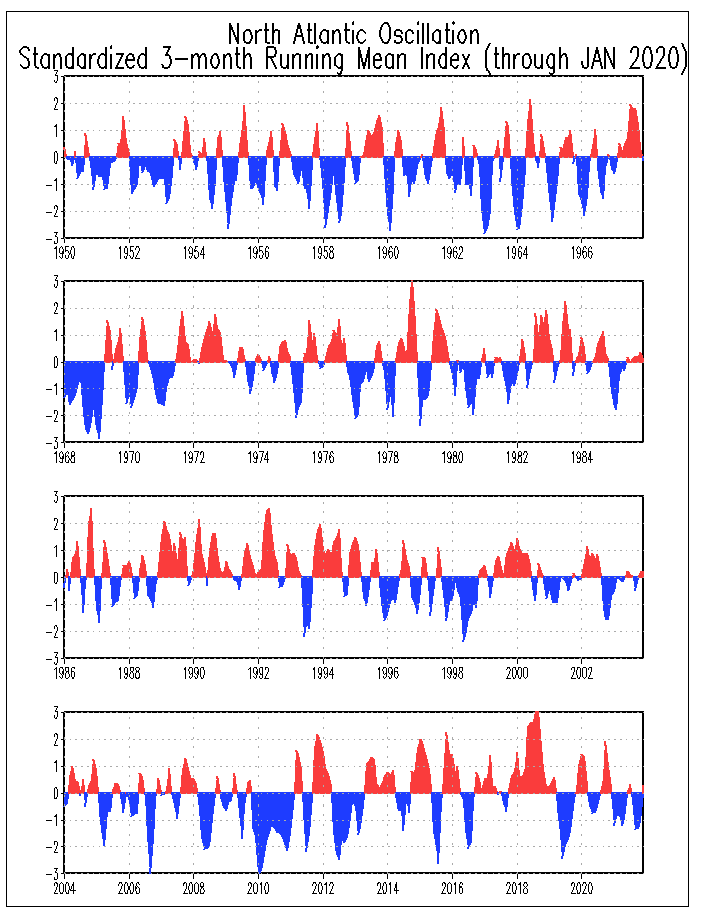
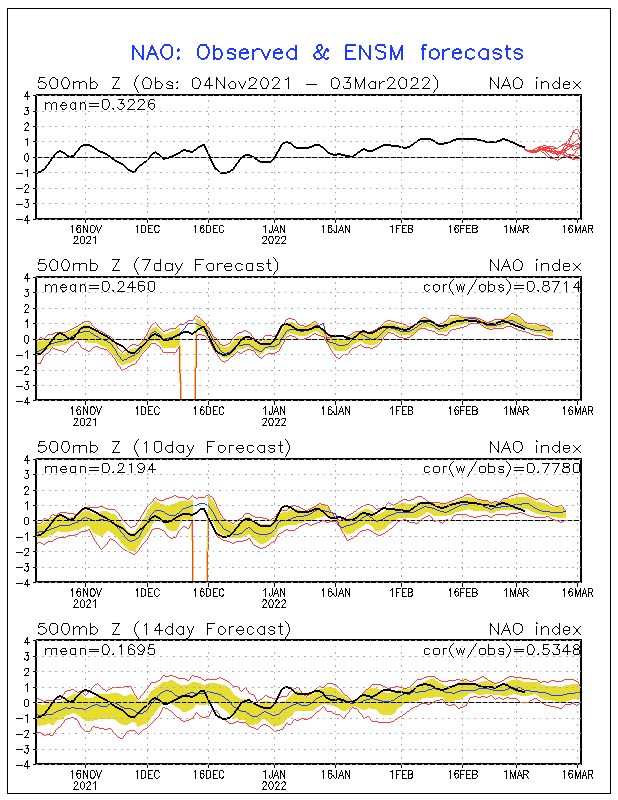
The North Atlantic Oscillation 2012-2013


I love this chart because of my understanding as to what it means to an Atlantic Salmon angler.  If you study it, all the information you need to predict what the coming season will bring is right in front of you.

We don't need more time than the first day of spring each year to grasp reality.  First let's take a brief moment to understand what this chart about the North Atlantic Oscillation represents.

Six years ago I started to study this climate phenomenon.  The direct relationship between low pressure and high pressure zones over the North Atlantic that dictate the available food supply for salmon during their winter months.  I have written in detail on this topic and you can review some of my findings on this link.   NAO Link

For the purpose of this post I would like to talk about the comparison of resent history and what has happened as far as quantity and size of returning fish over the last ten years.

If we call the red parts of the chart positive and the blue negative we have the basis of what the oscillation is to nature.  Positive is when the meeting place of the low to the north and the high to the south is north of the exact mid point between south and north of the Northern Hemisphere.  This map shows the results of positive and negative effect.
What you will notice is the arrow that is created by each of the two patterns.  In positive there are more storms traveling closer and through the areas where salmon winter.  In negative there is less activity and calmer conditions in those critical areas.

It becomes a simple process of understanding that when a species that lives close to the surface and relies of a concentrated food source to survive, any disruption in that relationship will cause added demise and weight of the predictor   The more climate activity over the winter that is created the greater the fall off.

Now let's go back to the first graph and analyze a few recent years.  The easiest being 2011.  Remember you are looking at the winter months and must take into consideration the end of 2010 and the beginning of 2011.  Is there any correlation that the deepest negative in the Oscillation occurred in the previous winter of one of the best salmon seasons in memory.  Look at the period between 1982 and 1994.  Certainly these were the dark days when we looked to find fault with everything from sea lice to seals as the reason for our salmons decline.  During the years between 2002 and 2008 there was as varied a range of success as the varied years in the chart.  Is it possible that natural climate changes that have happened since the dawn of time are to blame for good and bad alike?  I think so.  Here is another bit of the puzzle.  Why did the Stripped Bass populations grow so large during the 1980's through the early 1990's and coincidentally is the same period the salmon were in decline.  I suspect for the same reason only in reverse is true and I also think that dance is in the cards for the future.

So now we come to this winter and what we think is going to happen.  What do you think?  Looking at the chart for this winter it would seem to be somewhat even between positive and negative   The only other factor is if the beginning of a winter season is less important that how the winter finishes. Clearly the last two months have had greater negative position and this becomes a critical factor.

My feeling is that we are going to experience a very healthy early season this year and given some sense of relative weather patterns that are stable the overall picture is looking up.

Two things that I would have you do for your own conclusions would be first to consult any logs and history that you personally have gathered as well as go back and read the reports in the summer issues of the Atlantic Salmon Journals.  Perhaps you can be as convinced as I am as to where all the salmon have gone.


Tuesday, March 19, 2013

The Evolution Of Lee Wulff's Surface Stone Fly

Can you imagine any fly commanding a price of $3.00 in 1975?  The late and great Lee Wulff is remembered for many things relating to our wonderful sport of the angle.  He is the creator of the fishing vest, salmon tailer, the Wulff series of dry flies and the one item that is in every serious salmon anglers box, a modern version of the Surface Stonefly.
                                               
Tiger Stone Ghost Gremlin
The original, that you could purchase from Lee, was a hook with a molded plastic body that incorporated the parachute post.  The wing and spun hackle was all put together with glue.  No thread was used.  This made the fly light enough to be fished as a dry fly when cast up stream and then as a wet fly as it moved down stream.  The same concept as the Hornberg.  Over the past thirty years the evolution of the fly started in the valley of the Grande Cascapedia.  There it resided as a major part of the years catch in two distinctive versions.  The Black Stone and the Green Stone.  If you look at these photos you can see that the main theme is in tact as a few recent upstarts have taken center stage.  Each has the same formula but only the materials are different.  If you are headed to Quebec then a few versions of this fly are a must.  Stone Ghost Video

    Black Stone                    Stone Ghost                  Stone Ghost Gremlin


Friday, March 15, 2013

Is Your Fly Fishing As Much As It Can?????

I am a firm believer in the law of averages.  An average number of casts will produce an average number of fish.  I am also a believer that I can increase my personal average by the level of efficiency of my casting.  I watch other anglers all the time.  I am always interested in learning and for me the way to learn is to watch and then discuss what is happening.  I am very fortunate to have a circle of friends that are very proficient and willing to share.  Some I have known a long time and some I have just met last week.

The anglers that I especilly enjoy are the ones with the beautiful false casting ability.  Back and forth with no tailing or open loops extending line far to the other shore.  Or the anglers who are using indicators and weights with line choices that force them to make two and three rolling casts to get everything out there.

These situations are such a waist of precious time in a fast moving and limited day.  In my opinion the best casters are the ones that can get their fly from the end of a fish taking drift to the start of the next fish taking drift in the least amount of time.  I'm not saying that having a beautiful casting stroke is not a good thing or using a poor line choice will not catch fish.  What I am saying is that I am always making my equipment set up in a design to make as many drifts in a day as possible.

Al Buhr once asked me, "what is the best cast to use"?  He said, "the one that gets his fly from when it isn't fishing any more to where it is fishing again in the least amount of time".

The next time you are out fishing give this some thought.  It just might be the difference between a good day and a great day.  Keep your fly in the water and your casts per day above average.

William

Tuesday, March 5, 2013

Dee Flies Are Not Spey Flies

There is something very special about Dee Flies.  They represent patterns that seem to have moved on from the somber creations of the river Spey but did not go so far as the gaudy flies that came over the water from Ireland.  Each river had it's own distinctive brand of flies and materials.  I think the word Spey is over used and limits the course of history.

These are fishing worthy patterns today because the wings vary in color and the dubbing represent a similar look to our modern green but styles.

One of the best resource books for these flies is from Bob Ververka and called Spey Flies and How To Tie Them.  If you can find a copy for a reasonable price you will be very lucky.  Having a well rounded collection in your library is needed to have the full history of patterns and materials.

Monday, February 25, 2013

Modern Fly Crossovers In The Information Age

It seems to me that the differences between flies that can be used for Atlantic Salmon and Steelhead are melding.

Is an Intruder really anything more than a really big shrimp pattern?  Is the Syd Glasso style a River Spey fly with a different wing?  Bunny leaches designed to wiggle in front of North Western chrome are being found on the crystal clear waters of the Gaspe.

Years ago I would have never dreamed of using eztaz or a looped dubbing ball on my salmon flies but today in order to get a wide and full tail and wing it is the norm.

In days gone by rivers had individual style to their flies.  Dee Flies and Spey Flies are very different in materials and construction right down to the style of hook.  The headwaters of these two rivers are so close together that you would think there would have been more commonality.  Take New Brunswick and Quebec as a model.  The rivers are very different and so were the flies but if you were to check the fly boxes on the Gaspe you might just find a few Green machines in the mix.  You will also find creations that were designed for the Gaula as well.  Soft hair tied in a reverse full bodied style is all the rage in spring and fall no matter where you are.

My feeling is that the number one reason for such a crossover of materials and styles is the internet.  Every ghille in Scotland has a website and YouTube is loaded with great fly tiers willing to show their talent.

This is the age of experimentation and what will come out of it just might be an entirely new concept.  Materials and techniques are advancing rapidly.  Something is going to come of it, and when it does, it will be as fresh as the day the first Lady Caroline was fished.

The classics will never go away.  There is nothing more rewarding for me than taking a fish on a well tied creation that has been proven by time.  But who knows that magic elixir might just be one more tie away......

Friday, February 22, 2013

Do Predator & Prey Look Into Each Others Eyes?

There is a subject that needs to be thought about when it comes to building wet flies and streamers. Heads or Tails? Do you know what triggers an instinctual feeding response from the fish you are targeting? Do you know the inherent fight or flight mechanism of the prey you are imitating? Are the fish you're after chasers or slashers?

These basic questions need more study to offer us a better chance for angling success. Everyone has heard the expression "Short take". I have watched Landlocked salmon nipping at the tail of my fly over and over without the slightest feeling that it is happening. If my hook were positioned at the tip of the tail I might have felt a different story.

How about the possibility that the use of very small eyes in your fly might trigger a flight response from certain target fish. Some fish may need the sight of big wide open eyes to make them chase. For others just the opposite might be true. Lure makers have thought about this for years.

One day, in June, I was fishing on the Matapedia River in Quebec. We were in a twenty six foot Gaspe canoe moving slowly up river. In the clear water our guide noticed four salmon sitting together close to the left bank. My partner started with medium size flies like Lee Wulff's stone fly, and Black Bear Green Butts.

When it was my turn, I waded further up stream and choose to use a 5/0, very large, big eyed fly to swing right in front of them. All hell broke loose. The water raised four inches, one fish, about fifteen pounds, wet ballistic and shot three feet in the air and all four fish scattered as quickly as possible.

Certainly my three inch long fly was not large enough to bother a three foot salmon. Today I believe they looked into the eyes of death and instinctively ran away as fast as possible. I no longer use eyes that are large and might be mistaken for a seal, shark, or Swordfish when casting to Atlantic Salmon. My opinion is that the learned instinct of an animal species can make a big difference in angling. In turn, by removing the fear factor we offer ourselves a better chance.

Conversely, I have also read from the California School of Fly Fishing, that there is no eye contact between fish at all. Do bluefish slash through pods of bait fish and not look at the eyes of their meal? Do some salt water species have millions of years in developing a black spot on their tails for no reason.

Here is my conclusion.

I am now making sure that for Steelhead my flies will have no eyes and the hook is in the tip of the tail. For trout I have medium eyes and the hook is in the tail as I believe they are spotters and chasers. For Landlocked Salmon the hook is in the very end of the tail as they are nippers. For Bluefish and Striped Bass I use big eyes and have the hook right up close to the gills.  Atlantic Salmon flies will have small eyes.

My observations are just that and come only from experience. I would love to hear from anyone who has clear scientific studies that support or refute this theory.

You Call It! Heads or Tails.

William


Monday, February 18, 2013

Fly Tying Tip #131

I've been working on some big tube flies for early bright Atlantic Salmon fishing as well as patterns for New York State Steelhead.  The more I tie the better I understand how to make them wide and full.  Most of the time a fish is going to see a fly from the back and underneath.  That is the most important look to consider.  Using tubes with larger diameters is the key.  Creating larger tubes is easy and cost effective.
The beginning of this video shows how I create the larger diameter tubes.

Monday, February 11, 2013

The Nature, Senses And Instinct Of Salmon And Trout

For many years, many years ago, I fished out of a camp on the Marimichi River in New Brunswick, Canada.  The late Arlington Bamford said to me one day that the first thing I must do before starting to fish was to go down to the river and take a big hand full of gravel and sand and wash my hands clean.  "They can smell you", he said.

Salmon and Trout are wonderfully efficient animals that use the nature of their senses for survival.  These senses are switched on twenty four hours a day and to understand these basic tendencies is a requirement necessary to hold more than the stocked hook up.


Sight
Salmoniods have a distinct shape and composition to their eyes.  Somewhat nearsighted and without lids trout and salmon eyes are sensitive to light. They have a maximum range of approximately twenty feet and can see minute details up close .  They see in a cone shape that widens as distance is extended.  This is what is called the window.  Given the eyes unique location on the side of their body, there are blind spots that are directly behind, above, below and in front.  Full body movement is required to see in these locations.

A pallet of twenty four colors can be seen in full light.  The last and first color to be visible is blue.  In a total absence of light white and black can bee seen as white and black. Certain color combination's are better seen because of the distinct contrast that is created making one of the color enhanced.  Perhaps this is the reason a Mickey Finn or Blood Egg can be so effective at times. Sparkling adornments, florescent glows and vivid saturated colors can be seen better in low light and in discolored water.
Hearing
These fish have no external ears.  Hearing is achieved by the use of internal ears as well as the lateral line detecting sound vibrations.  There is a tonal range that fish can hear.  The human voice is outside that range and can not be heard.  Wading staffs, metal cleats and rapid movement can be heard and felt from a great distance.
Smell
The sensory ability of smell may be the most highly sophisticated attribute of the genome Oncorhynchus.  Able to detect the right or wrong smell in one part per billion puts trout and salmon in the top of this category.  
Taste
The ability to discern by taste equates to the selective nature of feeding.  The simple sensory choice is a matter of what tastes best to the fish at the time of feeding.  
Feel
This sense is divided into two different categories.  Natural feel and testing feel.  What is felt can be different than what is felt.  Trout and salmon feel every tiny vibration and change in current for a substantial distance.  They can even feel these changes happening down stream of their location.  Water is denser than air and the molecules will radiate vibration at a faster speed than the water is moving.  This is enhanced as the water temperature increases.

In Testing Feel we are using what little ability a fish has to be curious.  That momentary lapse in sensory auto pilot that will cause a fish to test if something is food or not. This test is done by the mouth using the other senses of sight, smell and taste.
Ability
Here is where all the above is brought together with the physical strength of
our quarry.  Lightning fast would be an understatement, being able to accelerate from 0 to 60 in one second, able to jump it's entire body weight two and three feet off the surface of the water, turn as sharply as can be and able to stop on a dime.

Our understand that we have a direct effect on how successful a day we will have is an understatement.  With only a fishes natural instinct to freeze when the slightest thing is not perfect is all they know.  They don't think, they just act. After working on this post for the a few days, I am thinking of the next time I go to the river.  I will walk slower, used my wading staff less, stay off the elevated boulders and wash my hands in the gravel.

William

Wednesday, February 6, 2013

The Purpose of Practice Is To Practice With Purpose

How often do you find yourself taking the time to enjoy the pleasures of casting practice?  I know that we all have angling as our first preference, but what about taking your casting skill to the level of the artful endeavor that it represents.

Even those gifted with the greatest of natural abilities must look at it this way and if we do then practice will have purpose.

Making the most of our practice time involves a level of readiness that we must be willing to create.  For me my rod and line are clean with the leader measured and the line slicked.  I have already gone over my video from the last practice, made notes and then created a new practice plan.  I stretch my line, set up my distance targets and then because I practice with both single and two hand rods I start both with the same exercise as a means to get into a grove and limber up.  The Overhead Cast.

This might seem too basic for most of you but let me explain why.  The elements involved in a tight loop overhead cast are exactly the same as the finish for all other casts.  Sure there are things like aerial mends to contend with but those are called mends because they are executed after the forward stroke.  There are also casts that involve the manipulation of directional changes in your line, but they are made by understanding what it takes to alter or enhance your grooved stroke.  I also make a point during this warm up to cast wide open loops as well as tailing loops with purpose.  To be able to control my line to that degree means I understand the physics as to what makes a good cast possible.

My practice plan is formulated by item and time.  I determine the amount of time necessary to do the job correctly and do no more or less than what the plan dictates.

You must know yourself.......

Never push your practice farther than what your physical and mental limits might be.  That is, unless you are studying for a masters level proficiency.  For those of us who simply want to improve only a limited amount of time should be spent for practice.  It is important that we stay motivated and have fun.   It is very important that we understand that the smallest of details realized during a practice creates major improvements in future practice.  These small findings are needed to create a complete understanding.  The perfect cast is made of many perfect moments in time.

There is only one hard and fast rule to observe  .....Eye Protection Must Be Worn.....


The fly stays in the box......

One important aspect of practice is a need to be in a state of mind that lets you concentrate on casting.  Feeling the grip flex and watching our body and the casts and thinking about every aspect creates the environment toward improvement.  Your mine must be free to think and come to conclusions.  Sometimes casting is a puzzle.  We watch the line and it is making a sharp little turn at the lay down and if we are having a fly on the end of the leader we might switch off casting to fishing mode much too easily.  Being in the mind set that casting is the objective is the first thing to do in order to improve.

What should I practice?????

A complete practice plan starts with an item.  Let's say a roll cast is what we decide.  The next step is not to go outside and start to roll cast.  The next step is to study the roll cast.

I do a lot of pantomime indoors getting ready for a practice element.    I take the grip section of my rod and slowly go through what I expect the movements will be to make a proper roll cast.  I go to my library, YouTube, IFFF site and my collection of notes taken and printed over the years.  I read, act out in my mind and write on my plan Roll Cast 12 minutes.  Because I have done my reading and study and even a Thai Chi dance on the roll cast I have prepared the set up and can have a very rewarding session with only 12 minutes.  I video every session from a distance far enough to see my body yet be able to talk to the camera with my notes.  Don't try to take written notes.  Use a smart phone or a tablet or camera but taking notes will only keep you from thinking and will add too much time to the process.

That's it.  The total circle is complete and you are ready to watch yourself, find the faults and write into your next practice plan an aspect or two in the roll cast that needs attention.  Say four minutes forming a larger and more pronounced D loop.

The total can be broken down to the sum of the parts to work on to complete the total.  Slow motion frame by frame is a great tool for this.

So, give it a try.  Improvement will be noticed paralleled by understanding and when you make that perfect roll cast  to a 5 pound brown, without thinking, the ringing in your ears is only the sound of Purpose coming through.......