Saturday, October 29, 2011

Big Fish Eat Tiny Meals - Midge Fly Time Is Here

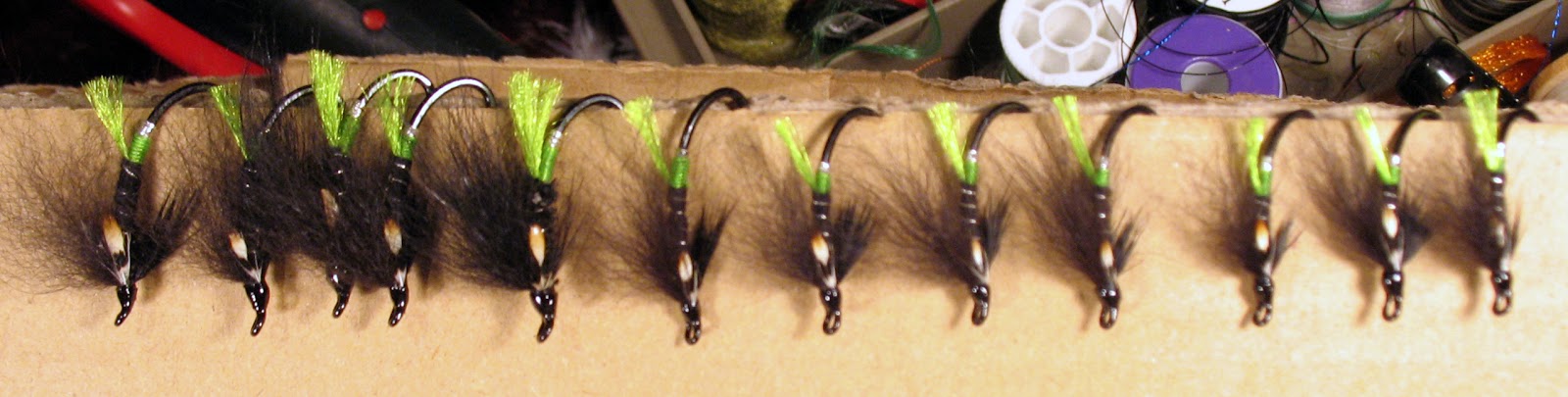
Last winter I made a decision to get very tiny with my presentations for late fall and winter.  By tiny, I mean using flies size 20 and smaller.  Because there are over 700 different non biting midge flies in North America, finding the best colors is going to be a trial and catch situation.

In addition to the simple larval form of the life cycle you will want to tie very small versions of flies like Pheasant Tails, Hairs Ear, Copper Johns and various Chironomid imatations.

During our regular season from spring to fall these tiny midges will go through a complete life cycle from egg to adult in a 2-3 week period.  This is why very tiny flies are all that fish will eat at certain times.  When I find myself in a situation where I know the fish are eating, and I can't get a hook up, I will get smaller and smaller in my selection and hope that size 22 and below will not be necessary.  You will have this happen more often in tail water locations.

At the end of the season the complete cycle will stop and suspend in the larval state through the winter.  November will start as the smallest and April the same pattern will have grown a bit.  I have been fishing for Land Locked Salmon at the end our New Hampshire season, and a very successful fly is the Olive Jailbird by Marla Blair in sizes 18 and 20.  I tie them from light to dark in color with dubbing as well as a very thin version with thread for the body.  Finding the red wire for the rib in a small enough size is a key element.

Because there are so many different possibilities for these flies, When trout and salmon fishing, I carry at lease 100 with me me at all times.  I build them in olive from light to dark, copper bodies with different dubbing for the heads, red from bright to blood, green from pale to dark, brown from tan to mahogany, with and without beads, with or without weight, with or without ribs, with or without flash and many different hook shapes as are made.  Over time I expect that I will keep track and learn what works best on the rivers I fish on a regular basis.

I have found that using a larger fly with a bit of weight and the midge as a dropper has been working the best.  Because of the size of the eye on these tiny flies I must use a lighter tippet.  For the weighted fly I make the size larger and use a heavier tippet.

23" Salmon #18 Jailbird
Because these insects go through a complete egg to adult cycle you will want to have a few dry flies that will work at times.  Because of the higher water temperatures on tail waters it is possible to have a need for emergers as well as dries.  A size 18 or 20 Griffiths Knat in black, grizzly and brown should work just fine.  I always have a few dries available because you never know when the condition  will be just right.

Don't let the tiny size of these flies intimidate you.  You will get used to the size and a pair of magnifying glasses is a big help.  Big fish eat small meals and at times it is the only thing they want.

William

Thursday, October 13, 2011

Fly Tying Tip #122

Wilde One 
A hook has a natural balance and weighting so that the point rides down.  Many of us are now using nymphing techniques that have flies with weight as well as adding shot to leaders.  Grabbing the bottom and loosing many flies becomes an all day affair.

One thing that we can do when building flies is to top weight so the fly will ride up side down.  At the same time tying the fly up side down will make things look right side up.  By laying one or two strips of weight along the top edge of the hook you can easily throw the hook out of balance and maybe loose a few less flies.

Tuesday, October 11, 2011

The Czech Nymph Style

Picture From The Jersey Angler Blog
Yesterday was a very interesting day, here in New England, for more than one reason.  First it was one of the top ten looking and feeling days of the year.  October can be an unsettled month and the last three days have proven record high temperatures and beautiful sunshine.  Not the best fishing weather but very comfortable to be alive and on the water.

Second, I watched an angler use a three fly Czech Nymph set up who was taking more fish than all the other rods combine. The only thing that was added to a standard Czech set up was a small wool indicator.

This is a very simple concept to understand and at the same time offers the most complete river coverage possible.  First you determine the depth of the water that is close at hand as you will be high sticking with as little line on the water as possible.  Only the indicator would be the best.  The indicator is usually a change in color of the top section of your leader system or a colored sleeve or spring that fits on the line where the leader starts.  Next you tie in three flies using the water depth as the total tippet length.  The middle fly will be a weighted Copper John or Bead Head fly that suits the location and will bounce the bottom.  Then in secession up and down you will put the other flies eight to fifteen inches from the middle fly.  The flies determined by location and condition.  You can also try to put the weighted fly on the bottom.

By the use of Triple Surgeons Knots you can create droppers off the main leader.  The leader is a flat line and all the same pound test.  The bottom fly is on the main line and the others are off droppers.

As you can see, this is not a very typical situation.  The weight is at the middle or bottom.   What I see most anglers doing is putting the weight higher up the leader and bouncing the weight with the flies hanging below.  This style is only fishing close to the bottom while the Czech style is covering three different water colums on every cast.  You can have your Stone Fly in the middle with Pupa below and  an emerger above and cover river bed to top.  This is the opposite concept of using a dry fly with a dropper.

All I can tell you is that this rig was doing the job well and tomorrow I will be giving it a solid effort myself.

William


Wednesday, October 5, 2011

Fly Tying Tip #121


As you are inserting a hook into your vise, never let go of the shank until the bend is firmly in place between the jaws.  I have shot hooks clear across the room when applying final pressure. 

Monday, October 3, 2011

Federation Of Fly Fishers Certified Casting Instructor

As you can read on my Fly Casting Page, I have worked very hard to complete this stage in becoming a quality single hand casting instructor.   This ability and understanding is necessary for me to feel good about who I am and what I am capable to be.  And especially what I can do for other anglers.

I am very proud to report that I have accomplished this beginning goal. This weekend I passed the written as well as performance tests to become a Certified Federation Of Fly Fishers Casting Instructor.

I want to say thank you to Rich Kovars CCI for keeping me on track and giving me the understanding that with a set plan and a dedicated practice schedule it is possible to be a good quality caster with the skills necessary to teach.  I will continue to learn and work to be better because as we know in this wonderful sport there is no limit and no end to what we can share.

William

Monday, September 19, 2011

Drift Boats On The Salmon River

As we move into October, many of us are starting to get serious about Steelhead in New York State on the Salmon River and the surrounding creeks.  My favorite time is through the entire month of November as the high level pressure of the salmon run starts to dissipate to a mild roar.  I always can find great water to fish with a fly rod even though it can get a bit tight at times.  November is not a time I worry about mobility as the entire river is accessible by foot and the weather and river height is usually manageable.

There does come a time, after this period, when the weather turns cold and the snow starts to fly that having the advantage of a drift boat comes in very handy.  Between the heater in the bow and the ability to fish many pools, having the boat may make the difference in a comfortable trip or one that has you working hard to see but a few locations per day.  I have made these trips a number of times and have enjoyed them fully.  Remember, you don't have to fish out of the boat all the time.  Fish the spots that are not available from shore while in the boat and wade the others.  Spot hopping is made easy and the amount of time saved adds about 25% fishing time to the day.  Long walks in the snow may be necessary when the places close to roads are crowded.

There is a difference in guides.

One thing that is very important will be to pick a guide with a boat that suites your style of fishing.  These fellows are very hardy folk and put in some hard days on this wild river.  I have fished it during high as well as low water and the navigation can be tricky at times.  Just explain how you like to fish and if you are into swinging flies then a guide who likes to back up plugs will  not be a good choice.  Some are now advertising that they are into two hand rods as well.  Talk it out and you will be in good shape.

In any case, now is the time to get your early winter trip planed and guide secure.  This is a very active fishery and the best are taken year after year early.

William

Sunday, September 11, 2011

A Day Of Gratitude

All this week I worked with the intention that I was off to one of two great fishing locations.  I tied Black Ghosts, Orange Red Dots, Stalcup Medallion Emmergers, Dick's Killers, Black Leaches, Wood Specials, Brown Owls and LaFontaine Sparkle Emergers.  This was only to replenish some flies that I knew I would want.  The car was packed and gassed, rods are lined and cleaned.  I set the alarm for 4am, retired early and was ready to go.

So what happened as I sit here in my living room watching the 9-11 ceremonies and find myself falling in and out of strings of emotion?

What it comes down to is that I was on my own today.  Today of all days I was not going to be able to drive three hours, fish all day and make the drive home alone.  It is hard enough on regular days to get up the ambition to travel and fish alone but today was impossible.  I woke, turned on the TV and knew that was it.  A little later my wife asked what happened.

So today on September 11, 2011, I am going to put the pleasure of fishing on the side and remove it from my mind.  Alone is what so many have suffered for the last ten years.  Alone is what the brave wives, fathers, husbands, daughters and and sons of our fallen will endure today.  Alone is something that you do because you have no choice.

With so many in our great country living with such empty feelings and the hardship of true loss,  I will spend this day at home with my prayers, hope and gratitude for those who have given so much for me and my family.

William

Fly Tying Tip #120

When we look at flies that are time honored,  there is a simplicity and purpose to the materials.  Keep your work simple and use less rather than more.

This is The Wood Special created by Joe Sterling in the 1930's.  Notice the symmetry of back and front and the vibrant choice of contrast in the center.   Almost like Joe was sending Morse Code.

Many great flies share this composition.  Keep things simple with dots and dashes in contrast and not only will your tying improve but your catch rate as well.

Tuesday, September 6, 2011

Skating With A Shadow

That first morning was just a wonder to experience.   With the crispness of an early fall and the smell of a fires warmth filling the air, I was giddy with anticipation.  With the sun coming up red below a wall of clouds moving in from the west,  I gazed down the big Restigouche River taking in the magic of light that Northern New Brunswick can display.  My heart was at peace and a feeling of being fortunate overwhelmed me.

In my life as an angler of Salar, there are few places that can stir my heart as distinctly as having private pools on one of the most majestic rivers in the world.   You say names like Alta, Cascapedia, Litza, Gaula and then you whisper Res-ti-gouche.  Restigouche as it rolls past your lips sounding like a lost brother.  I am allotted two days in this part of heaven and intend to make every minute count.   My long time guide is ready and I have looped on a big SunRay Shadow for my first pass through the pool.  We take the boat well above, cut the motor and quietly drift to set the killick.  Time is standing still......The ancients are watching and I am among friends of sole purpose who have long past.  The ritual is being repeated.  The time before is gone and I am now thrust into history.

The Shadow is a big fly even for a river like The Restigouche .  It's four inch wing of black will slither close to the surface as the construction is on a plastic tube.  You pulsate the fly to increase the action as it swings through known salmon resting places.  Mine and my guides eyes do not leave the path of the fly as the take will be a big boil and savage eruption of the surface.  This is a fly fished in a style that a salmon will chase and take with great furry. 

The history of these hallowed places has been kept hidden for over one hundred and forty years.  I am not talking about the surrounding history of the people and who, where and what they did.  I'm talking about what happened in this very place when water met fly and fly met salmon.  Sure, we know about the politicians and money magnates that have owned and experienced being part of "The Club" where wealth, fame and power are required for entrance.  But we don't know a great deal about the fishing as if enrollment in the society came with a contract of non disclosure.   This very limited access, as well as low profile is one of the factors that has kept the river alive through some very hard times.  The old and limited public records offer some clues.  With angling in double digit quantities per day and fish over forty pounds common, gleaning the rivers potential as well as what can not be achieved today is clear.  The famous Patamagaw pool that has world recognition as Million Dollar, once held thousands of salmon by the middle of July and will now hold a mere five hundred.  But that doesn't sound so bad now does it?

A wind from the west started to rise and pushed the clouds over the edge.  I don't like the west wind as it always feels like it is rushing things and seems to mostly have a northern dryness.  I think it drops the river quickly and makes the fish feel a bit on edge.  As a few hours went by without so much as seeing a fish move, I was taken over by memories.  Drifting in and out of present to past becomes easier when fishing is mechanical.

"Oh, did ya see er", the ever vigilant guide said.

No, I wasn't looking, I said.

"A big boil behind yer floy".

I let my line dangle for a few moments to give the fish a chance to return to the place of comfort.  Then the same cast with the same amount of line and my attention is now in video game mode.  Take it, Take it! Nothing happens.  At least now we know that the possibility is there and it will take a bit of time for my mind to be drifting off the prize again.

At that moment I heard the voice of my father singing in the wind.  I was only a young boy the first time I sat in the bow of a Gaspe boat.  The feeling of a gentle rocking with the sound of the river slapping it's way past and on to The Bay of Chaleur.  I smiled with both a feeling of loss and the appreciation for knowledge that was taught to me would be true.  "You are a Restigouche man", he would say.  "And you will know what to do when the time comes for decisions".  My farther thought that salmon angling was as close a description for a good life as a person could experience.  You start off with very little and with great effort you learn how be successful.  Each persons success is different and we all have a shot at the jackpot.

The voice again was in my head.

"Watch what I do here Billy."  I just raised a fish and I am letting it rest.  "Now, I'm gonna pull in about six feet of line and then make a cast"   Add six inches, six inches more, six inches.  "Fish on", he said!  And now time and generations will play with each other and what I learned will be displayed as it has so many times on this river of light.

As we removed the Sunray from the salmon, I was thrilled.  The fish, by Restigouche standards, was average at best but the process was fulfilled and that means something of great importance.

I thought how Pop would be proud as we went in for dinner.

I love the evening session.  From the moment the bell goes off I have a great sense of urgency.  I know that dark is close enough at hand and will come far too quickly.  Strangely, it is the edge of darkness that is needed for the fish to come alive.  This is the time that shows who we can be, and the level of our talent will fade quickly with the light if we are not up to the game.   I do see many anglers push the darkness much farther than I do.  I feel they are the desperate ones who for some reason have not lived with satisfaction.  I have hooked fish close to dark and landed them in pitch black.  Not very good for the fish if you are releasing it back to the river.  I know that they are looking up and the sky offers just the right background.  I also know that a salmon can see both white and black in total darkness.  They can see blue until the lights go out.  I tied on a Black Dose in size 4 as the clouds turn dark losing the translucent glow of the sun for another day.

On the forth cast and very close to the boat I had a very strong take.  The fish turned on the fly and was running as fast as possible toward the sea.  My reel was singing as only a Hardy can and in a matter of blinks the fish was jumping through my backing.  The river is very wide and has few obstructions to hinder the playing of a big fish.   Your biggest issue will be the current taking the belly of your line in places that direct the fish and take away what little control you might have.  We pulled the killick and started the motor.

Drifting slowly as I tried to get a bit of line back on the reel the fish decided to now come straight up river and directly at the boat.  This wasn't really happening, was it?  Now I had all line back and the salmon and our path directly converged.  I stuck my rod tip in the water on the down stream side of the boat and moved to the bow to clear the rod all the while the fish charged up river.  I really don't like changing the angle so much as it can cause harm to the fish as well as loosen the grip of the fly.  Dark was now coming fast .

As we motored to a side position close to the river right shore I was able to exit and at this moment the fish sounded.  When a big salmon sits itself on the bottom and refuses to move you are at the fishes mercy.  You can throw rocks, splash an oar or you can "Play the Guitar".  I tightened up firmly and started to strum a one note tune.  Pull a little harder and pitch goes up.  Then a bit of movement and we could now work the fish to shore.   The darker it gets, the more I dislike the situation and the more risk I am willing to take.  I don't want to over handle the fish and I don't want to have it on the line more than necessary.

We had the fish in hand in just a few more moments.  My guide ran his hand down the leader to retrieve the Dose and without so much as a lift out of the water the prize directed one good tail slap with a spray of water in my face and was gone.  Tomorrow would be here very soon now.

They say the definition of insanity is doing the same thing over and over creating the same result.  Sounds like successfully chasing silver to me.....

William

This story is a excerpt from "Angling as if it Were True" A collection of writings based on a life of experiences. 


Tuesday, August 23, 2011

Anticipation Of Fall Trout & Salmon

Man the summers are hard in New England.  Most waters south of the 45 parallel are just too warm and low these days.  The trout and salmon retreat into the deep lakes and the rivers are waiting for an autumn flush.  The north country and the few bottom release dams there will continue to fish well all summer.  These are day trips that can ware you down and be costly given the price of gas.  They are wonderful vacation spots with great fishing available from dawn to dark.  I go because fishing there is as close to perfect as an angler can get.

After one of the best spring seasons I can remember, I am now hopeful that the fall will bring a few trophies to hand.  This is a time of migration, as well as emigration, and you need only find the ins and outs of all the major water bodies throughout the entire region.  What is needed to kick off the season is that first major rain event.  I noticed there is a hurricane headed north after the week end and  heavy rain is expected for all of New England.

The first thing that will happen will be for trout to emigrate over dams.  They feel the water in the lake start to move and get close enough to be pulled into the flow.  These will be big fish and can reach twenty eight inches with most in the eighteen to twenty one inch range.   The possibility of this happening will increase between now and the end of the season.  Every rain can add fish to the system.

The major salmon runs will also start in the far north and continue in location farther south through the month of October. In a few cases the run will not happen till after the season closings in November.  These landlocked salmon have the same make up as their larger Atlantic brethren.  When Atlantic's spawn is also determined by latitude and happens from late October and into November.

A lessor known migration is that of the Brown Trout.  If you are lucky and hit these locations the last few days of the season you can be in for a wonderful surprise.  There are some locations where the browns are very large and they will move up to dams from lake and river locations.  This can happen from mid September through October.

The bows are a mystery to me.  I have been told that because these fish are hatchery raised they think that their naturally spring spawning run should be in the fall.  Although not the target of migration they are a big target for me as emigraters.  I have released my largest Rainbow Trout during this fall season.

This is also the time of the Brook Trout spawning.  Maine is alive at this time right to the final day of the season.  I love heading to Rangely with the anticipation of some wonderful angling.  This is New England in the old time tradition and I make at least two trips every fall. 

Between the beginning of September and the end of October you could fish a different trophy water each and every week and never visit the same location twice.  There are more of these hollowed waters than most of us can imagine.  What determines the place are the conditions and the conditions are determined by the rain.  Follow the weather and the river flow charts.  Make yourself a collection of these links and study them year after year.  You will understand what is the good to bad flows and having this info will help you make knowledgeable decisions.

William 


Saturday, August 20, 2011

Fly Tying Tip #119


When ever you are using light color materials make sure that the thread is lighter in color than what is being tied.  At some point in the tie you will be able to switch to the final head color.  What a fly looks like dry can be very different when it gets wet.  Sometimes the material used will get translucent and what is underneath will show through.  The fly in the photo is a perfect example of what happens when the dark brown head color was also used in the body.  If you enlarge the photo you can see through the mylar.  Light green or chartreuse would have been a better thread choice.

Tuesday, August 16, 2011

There Are No Bad Days On A Salmon River

There are no bad days on a Salmon river, there just is no way to explain the feeling to you if you have never tried the game.  I'm home today from a wonderful but all too short trip to Matane.  The river is more than alive this year.  Every pool has a few fish and some have over one hundred.  It is a wonderful thing to see after so many years of waiting and hoping.

The Matane is like no other river I fish.  This is mainly because of the ease of access and the fact that most of the rules are created by the local people.  This is a kill river where only 28 of the over 600 angled this year were released.  Now don't get yourself in a tizzy as this is a very healthy river.  The fact is that should enough salmon spawn and the eggs hatch there will be so many Parr that they naturally die off because no river can accommodate a quantity greater than the balance of nature will feed.  Rivers like Matane and Matapedia, where there are high kill ratios do very well and should there ever be a problem the solution would come swiftly.  In Quebec the numbers are monitored very closely and rivers will close.
There are two other things that I became aware of during this trip.  The first is that there is no official limit to catch and release.  My personal number is three. Most local people would like the number to be two.  The local officials would like three.  Some locals would like the number to be one, the same as an angler who takes a fish.  I think that you could surly find a few who would like catch and release eliminated.  I will leave the controversy over weather catch and release is a good thing for the answers that will hopefully be complete shortly.  Studies in fact are underway and are not being conducted in a laboratory.  Time will tell.

S.S.S.
The other thing, that to my knowledge, is unique to Matne is that the rotation system is conducted on both sides of the river as if one rotation were in place.  This is a foolish practice to me.  It makes for arguments and the possibility of bad feelings.  No one is more understanding than I am in relation to fly fishing etiquette, but having to worry about the people on the other side of the river is not necessary.  That said, the next time I visit Matane I will respect the local way.  I will also expect that the one person on the other side will wait for all in rotation to finish before starting again.  See what I mean about the policing?  

The fishing was very interesting and I was able to land a few with some very unusual flies.  I had many takes to my Super Salmon Sedge(S.S.S.).  I love dry fly fishing and I am tickled that my fly worked.  The other thing that worked was by rapid stripping.  It was really exciting to be casting and then stripping big Flat Head Muddler Tube Flies as fast as possible.  When the salmon hits it causes opposite reactions resulting in the water dramatically exploding.  Very exciting to see, and more exciting that it happened to me.

For long time Salmon guru or for your first Salar adventure, the Matane is every bit a prize.  This years quantity of salmon is the bonus.

Full Moon Over Matane


Sunday, August 7, 2011

A Salmon In Every Pool

Never in my entire life with Salmo Salar has there been a year like this.  Most rivers are seeing record returns as well as some very large fish.   There are a few down spots in Newfoundland and Nova Scotia and for those rivers the work goes forward.
Maine
My first salmon came from the Narraguagus River in Cherryfield.  166 have returned this year and it makes me very happy to see so many when there were years with but a scant few.  Penobscot is tipping in the 3000 range and fish are traveling farther up stream as the numbers needed for the hatchery were met in early July.

New Brunswick
Reports that I am reading on NewBrunswickFishing.com seem to have a lot of very happy results.  Numbers on all the major rivers are way up and it is common to hear of three fish days.  One of the reports was on the Nashwaak River.  This is my favorite New Brunswick river.  As it is a Bay of Fundy river it is now closed, but the numbers in the spring run have been very impressive.  The Marimachi system is also seeing good numbers.  The Restigouche reports are scarce but in the upper reaches on Crown water anglers are seeing and catching fish in good numbers.

Quebec
Nothing short of spectacular can be reported.  The numbers angled on the Grande Cascapedia are higher than the usual total quantity in the river.  It started early and is still going well.  From Matapedia to Matane and out to the tip of Gaspe things are going very well.  Bonaventure seems to be having an above average year but not as impressive as the Petite and Grande.

Nova Scotia
They don't seem to be having the same luck as other locations.  It seems that acid rain and fish farms are still a big problem in the south and Cape Breton rivers are not seeing the numbers of last year.  Margaree summer fish are coming in good numbers.  Most pools are fishing well.

Newfoundland
Salmon counts are running less than last year for most rivers.  Above the ten year average and looking better but not what other locations have seen.  The Harry's River is the shining star and showing a dramatic doubling from last year's good number while the Torrent has seen only half last year's total.

Labrador
Numbers are very strong for this year.  The Sand Hill is seeing over 7000 fish to date, up from 1700 this same time last year.  Reports from the Flowers River are very good and some large fish being angled.

Iceland
Off to a good start in both quantity and size of fish.  As the rivers of Iceland are July to August rivers we will need more time to tell the complete results.

Scotland
The numbers and size this year in Scotland are mind boggling for most locations although rivers like Beauley are down.   Some have seen strong early runs that slowed just as quickly while others are still in good shape. It will be very interesting to see what happens with the late runs.

Monday, July 25, 2011

Fly Tying Tip #118

Make sure that your hands are polished and smooth.  Use a fine emery stick and work on your nails as well as the entire tips of you fingers.  This will keep thread and floss from sticking and gives you the ability to hold materials down and have your thread circle your fingers with ease.

Saturday, July 23, 2011

FlySpoke Black Bear Green Butt Order

Here is the first fly order from the FlySpoke Shop.  I hope the buyer is as happy as I am with the results.  I used Arctic Fox for the wing because of how wonderfully it swims.  The only material that is better would be Temple Dog but that is illegal to possess or purchase in the USA.
I also used a very beautiful Salmon hook from Daiichi.  #2161

Friday, July 15, 2011

Saumons Atlantiques Sur Le Fleuve De Matane

Atlantic Salmon On The Matane River.  Flowing north out of the Chic Choc Mountains the Matane empties into the Saint Lawrence Seaway at the Village of Matane, Quebec.  It is called The Salmon School by many because of it's ease of access to the many pools as well as the river's gentle and steady decent.
August 4, 2008

The river opens in June when the larger fish come in,  but the main runs enter the last week of July and through the first ten days of August.  There is a dam at the very bottom of the river with a counting observatory.  This is a must see during the height of the run and also gives the anglers on the river knowledge of the quantity and size of the fresh fish in the system.  It is very exciting to hear that a very large fish has just passed through.

One of my favorite pools is called Grande Tamagodi.  The pool is broken into two distinctive parts.  The top is a rapid with Grande Tomogodi Stream entering the main river.  The bottom is a wide flat glide that is the finest looking dry fly water I have ever fished.  A number of years ago, Leo and I were on the pool.  I have been in a dry fly state of mind for some time now, and to see the glide was just too much to pass up.  A far greater number of fish will take up residence in the upper pool but when the river is right there will be the perfect opportunity to fish the glide.  My favorite Matane dry is the Canuel. Created by Raynald Canuel of Rene' de Matane and made to fish in a smaller size than the usual big Gaspe Bombers.  They say on Matane that the big bomber is to attract a salmon and the small one is to catch them.

I started casting in short drifts, from my river right position, starting at the very tail of the slick and flicked each cast a foot higher.  When I made the final cast as high up river as possible I let the fly dead drift all the way back to the tail and was sucked in a millisecond before I was going to pick it up.  What I am going to tell you is true, will never happen again to me or possibly anyone else, but true none the less.

Grand Tamagodi, Fish On
This was a big fish.  Twenty five pounds or more and acting as crazy as a salmon gets.  The first charge was a violent surge directly up stream that put a birds nest in my reel.  I hate when I am so stupid and don't make sure all is right.  I profess always making everything right and am guilty of not listening to my own good advise.   Such a simple thing to check.  While I was fumbling with my line, the fish made a sharp left and directly at me, another sharp left and like a rocket down stream, then making a 180 degree spin up stream with one big jump right into the circle of line that had been created while I fumbled.  This all happened so quickly that it took me some time to figure it out.   Now what do you do when a crazy twenty five pound salmon has tied your fly line in an overhand knot.   There was no way to hold the fish as I was on eight pound test and when she ran over the rapid directly below the pool it was over.  It pains me to even tell the story.

I have a few lessons that I learned that day.  First I will never use eight pound test for salmon unless it is Maxama.  My drag was set light because I was afraid that the leader material needed to be treated with caution.  Second, I will never let a fish get directly below me without immediately moving down stream as quickly as I can.  I will run if needed, and I will not hesitate.  A straight down river position is the least forgiving angle that you can have.  The third is that I love the Matane.  Watching a dry fly disappear to a big fish is fly fishing on steroids.

With August approaching rapidly I have made plans to be in Quebec.   The idea is that I will start with a dry fly and end with a dry fly.  Or maybe throw a big Muddler for a while.

William