Friday, December 24, 2010

Peace And Good Will

 
On this Christmas Eve, as I approach the start of the second year at FlySpoke.com, I want to thank you all so much for your readership and e-mails.  I am truly blessed and joyfully surprised at the number of you who visit from the four corners of the angling world each day. 

Merry Christmas 
And A Happy New Year


Wednesday, December 15, 2010

The Midge Fly - So Many Choices


There is nothing like a good midge.  So many colors and variations will work and they are not only for the winter season.  They are simple to tie and use a limited number of materials.  Take a size 18 or 20 wide gap scud hook with a body of thread, a rib of mylar, mono or fine wire and then choose a wing casing or bead and a bit of dubbing.   Try black thread, silver wire and a silver bead.  It's called the Zebra. Be creative as there are so many different Chironomids that it would be hard to be wrong.

Friday, December 10, 2010

Fly Tying Tip #105

There are certain patterns that are our go to flies. They need to constantly be replenished.  Some days, it seems, I lose enough of them to open a well stocked fly shop.  Because I don't ever want to run out, I am forced to the bench.  For those flies, shorten your time by gathering the materials and put everything in a zip top bag.  Label the bag and replenish materials as needed.  Easy start, easy finish.

Thursday, December 9, 2010

Is It Winter Yet?

Well, I guess it's time to light the fire, tie up some flies, drink hot chocolate and wait for the rights of spring.   You don't buy that line do you?

Winter is a time to make the most of your rivers by changing the mindset of the approach.  Do you know the sound of  snow falling softly through the trees when the wind is still?  Or the gentle crackle of the hard woods swaying after a sharp freeze?  Some of the most memorable days possible are within your grasp right now.  Everything changes and so will you.

Slow - Not only should your fly presentation slow down, but you should move a bit slower and not take any chances of falling or getting wet.  When water temperatures go down so does the metabolic activity of a trout or salmon. They don't chase and tend to be in the deepest and slowest part of the pools. Your challenge is to hand feed the fish something that they will open their mouth to eat.  The other thing that slows is the rate of any insect activity in the river.  Mostly what will be available will be small larva and midges.

Low- Because the speed of things slows dramatically the fish will congregate in places where any food source will settle and be easy to catch.  Look for the deepest holes in the run and fish as low as possible.  If the fish are there they will eat all winter long.  You have a good chance at the largest fish of the year during these times.

Flow- Mid December starts to bring the snow and ice to the rivers of New England.  The further north you are the deeper the freeze.  Rains turn to snow and the ground holds the flow down.  River fluctuations are rare and you can learn the winter spots to go back to each time.  Even way up north there are tail water locations where the water temps stay in the 40's. 

Big & Small- When making fly choices, I tend to go big with marabou leaches in drab colors like black, brown and olive.  I will use this fly with a bead head in various sizes and weights and then add a very small midge type fly as a dropper.  WD40, Zebra, Brassies and other flies that imitate the family Chironomidae will all work.  As there are over 700 different species of these non biting midges in North America you will want to cover a number of colors.  Red, Crimson, olive, copper, black, brown, chartreuse and green are a few good choices.  Mix it up between thread and wire for the bodies.  Also Prince Nymph, Pheasant Tails and Scuds can be effective at times.  Just for that momentary magical time carry a few midge dry flies in white, grizzly and tan.  I have been told of trout feeding on snow flakes.

Some of us have no problem driving from southern New Hampshire all the way to the Great North Woods.  How about the other direction?  There are rivers in Connecticut, New York and Massachusetts that are open through the winter as well.  They have fall stocking programs and receive some of the largest fish at this time of year.  What makes the narrow choice of rivers large is that you will be alone for the most part because so many anglers can not put up with the cold or don't like the winter for fishing.   The peace of the woods is paramount during these shortened days. 

Warm-  Stay warm.  Having layers and a good pair of boot foot waders will keep you in good shape.  If you are feeling really cold you should head for the car.  It is very easy to miss judge how cold it gets when you have a river taking your body warmth down stream.  Shorten your day, be very direct in your approach, travel with a buddy and have liquids, food and fire capability with you.  Never walk on shelf ice.

Fly fishing is a twelve month season in most states.  So long as you can handle the line freeze, the feeling of solitude and the shorter time you will find the wonders of winter.  Just pick your days.

William
I took my own advise today, 12-11-10, and landed this beautiful 20" Brown Trout on a #20 Red Midge.


Sunday, October 31, 2010

I Am Haunted By Fishes.....

These are the days that determine our creed. the code of our angling ethics.

Yesterday I ended the Landlocked Salmon season on one of my favorite rivers.  Usually during the last few days, as the season close is the 31st day of October, flow is blown out and swollen with snow falling.  Under normal conditions I am fishing in a more southerly location of New Hampshire for the finish.  This year the rains came early and even with the river still high I hoped it would fish well.  It did not.

Starting high up and working down river proved a casting experience.  I knew the fish were there but, for what ever reason, their jaws were locked.  I then decided to check out a run that always holds a number of fish.  It is heavily angled when the water is low enough to access.  By this time the fish have been there for a number of weeks and seen a whole bunch of flies.

Working down from the top of the rapid I was stopped dead in my boots.  Frozen in time and stilled with amazement as there before me was the largest Landlocked Salmon I have ever seen.  Next to that fish was another that was by Landlocked standards a true monster.  My guess was seven pounds or more.  I had a copper bead headed olive leech trailed by a Stalcup Caddis Emmerger on eight pound tippets.  I have learned that when fishing the new co-polymer leaders, available today, I no longer need to be using very low pound tippets.   Tied with Davy knots I have become very strong with the playing of the fish I hook.  I backed myself up into the bushes and made a cast in a dead drift nymph style.  Three casts later the big one inhaled the leech and I was in heaven.  One strong run up river that included a surface clearing jump and then pulled back to my feet.  I tried with my net and the fish bull dogged forward and away.  Close but not close enough.  Two more times and the same thing happened.  As I was working this magnificent salmon back for a forth try my barb free leech came out and the trailing fly caught in the fishes tail.  Having none of that, with one good tail slap she was free.

Now, I have been professing using barb free hooks as this blog will confirm.  But at that moment I lost a fish of a lifetime and I am almost certain that a barbed hook may have held tight.

"These are the times that try men's souls"  Thomas Paine said that.  "These are the times that make me want to throw in the rod".  I said that.

Later, while packing for the day, I stuck myself deep with a size 8 olive leech.   A moment of panic and then  the point being driven home.  It slipped out of my finger with ease.

Today as the vision of that fish dances in my brain, I have been wrestling with the choice of a possible trip to the hospital verses a photo with the largest landlocked salmon of my life.  This is really a hard one...........


Thursday, October 28, 2010

Salmon River Spey Question.......

Reader Question:

How are you?  I was wondering if you could give me some ideas on what type of leader you recommend for swinging Spey flies (size 1.5 to 5 Daiichi Alec Jackson Hooks) on the Salmon River in NY?  I've been fishing the 750cfs flow.  I'm using a 13 foot Dec Hogan with a Balastic Scandi Head.  Any help would be appreciated.....since I'm still very new to the Spey. 
 Thanks
FlySpoke Answer:
If the DH is an 8 weight it is perfect.  You have asked a question with many answers.   You are limiting the possibilities by using the Scandi.  Let's first look at the difference in three different styles of lines.  Each has a belly section that is the part of the line that propels your cast.  The belly on a Short Spey line is further back from the front of the line than a Scandi.  The belly of a Scandi is further back from the front as a Skagit.   The Skagit belly is more a barrel and extra heavy close to the front of the line.  The only other option that is on the horizon is coming from Rio.  It is a hybrid of a Scandi and Skagit they are calling The Steelhead line.  I hope to give one a try soon.

So, on the Salmon River where casting room is limited at times and you are wanting to use larger Spey style flies and you need to use sinking tips and poly leaders, I go with the Skagit.  You call your favorite line company and you tell them the rod you have and they will match the line grain weight exact to the rod.  There are both integrated as well as heads available.  I am using the Rio system and changing heads as needed.

Now, you need to have a collection of tips.  Tungsten gets you really deep.  These you make loop to loop connectors 3 feet, 5 feet, 7.5 feet and 10 feet.  The longer the tip the deeper you go.  You will also want to have a collection of poly leaders.  These are tapered coated mono that are available from a wide range on vendors in lengths and sink rates.  You could easily buy 20 different heads today.  I first purchased poly leaders while fishing in Scotland when no company or store in the US(well, East Coast Anyway) ever heard of them.  Today they are a standard.  Make sure you check the strength as there are now trout options and I go for the 20-24 pound strength.

Tippet is connected to the sink tip.  This now varies depending on depth and the sink tip you choose.  Last week I was fishing Atlantic Salmon in Nova Scotia and the water was up a bit.  I used a 12 foot poly at 6.4 inches per second sink rate with a 10 pound Maxima at 18 inches.  The longer the tippet the higher the fly will ride from the bottom.  This is something you need to experiment with.   When swinging flies for Steelhead the leader does not need to be as small as when indicator or nymph style fishing.  The leader is always behind the fly and the fish really can not see it well from that angle.   If you like fluorocarbon, there is no need to go lower that 10 pound test.  I do not taper the leaders.

The last piece to the puzzle is how do I keep my fly fishing deep without loosing too many flies on the bottom.  I am working on an article right now called "Loosing weight one shot at a time"   I am building trout and Steelhead flies weighted so that the hook rides up and the Spey flies are built up side down.  The amount of weight in the fly is another factor you must understand when choosing the fly on the piece of water you are fishing.  This is not a new concept but one that is not available to the non tier.  

So, I hope this helps a bit.  If you want to stay with your Scandi, then just do the same thing as I say off the tip.  It will be harder to cast and use more room around you but it will work.

If I can answer more specific questions please feel free to ask.

Always the very best,

William       

Tuesday, October 26, 2010

Tails You Win, Heads You Lose

A few weeks ago I was fishing one of our northern rivers for Landlocked Salmon. The water was very high, the highest I have ever seen. After working hard all morning in slack water areas and behind boulders, without success,  I made my way back toward the car and met a few very interesting people.  Two Canadians, a couple who had just purchased property in the Great North Woods, and a fellow from Vermont named Mark Wilde.  After a longer time than I am usually willing to take from my fishing day, I'm not anti social but compulsively driven,  Mark and I decided to head down river together and fish a long straight run that is a staging area when the fish are on the move.  My good friend Leo was working his way down river caught up and the three of us made cast after cast and saw nothing at all.

Next we decided to give two different locations a go.  Leo and I went to the top end in the car and Mark wanted to try some of the middle runs. We would meet at 2pm to go to another river and fish for big browns.

Mark is a fishing guide in the state of Vermont and getting another river into my experience would be a positive on the day even if no fish came to hand.

Well let's just say I was a bit off the game.  I found myself sitting down on a big rock as Leo made a difficult trek down river to fish a few pools from river right.   Now close to 2pm I was hap hazardously throwing a few casts in the upper run when it happened.  Bang, I brought a nice nineteen inch salmon to net.  Leo showed up and while he was going to get Mark it happened again.  Another nineteen inch salmon.  I swear they were the same fish.

As Mark and Leo returned we exchange some info and I gave Mark the fly that was working.  Later he showed me the flies that work for him and the difference in the style and sizing was startling.   My box was full of small size 16 nymph like creations and his was chock full of leach looking stone fly  patterns in a number of colors.  The most interesting part of the fly was that they all keel point up.  They are weighted on the top and sides of the hook so that when in the water the hook point rides up and does not hang up as much.  This fishing requires a bottom presentation and this tying technique offers a way to fish more and tie knots a bit less.

Oh, I almost forgot to mention that we continued to hook a few fish.

So thanks to Mark I now have a piece of the puzzle confirmed for the next post.  Maybe I will call it "Loosing Weight One Shot At A Time"

Mark catches fish.  He is available as a guide and I recommend  that you give him a call.  He can be reached through this link: Uncle Jammer Vermont Guide Service.

Tuesday, October 5, 2010

Margaree Copper Killer

1.5 Alec Jackson Gold Hook
Copper Wire
Green Floss
Red Golden Pheasant Breast Feather
Chinese Red Wool
Flat Copper Tinsel
Copper Wire
Bright Orange Hen Hackle
Red Squirrel Tail
Red Clear Head 4 Coats 

Monday, October 4, 2010

A Moment Might Matter

It was 3am on a Saturday in October and the anticipation that had been building for almost a year was in full gear.  I had a three hour drive, stoked by adrenalin, to be on the river with the anticipation that I would be the first through the run.  I just love using my two hand five weight switch rod to swing and bump for salmon.  No back casts in tree lined areas and the ability to switch over to nymph drifting where needed.  If you don't own one you are missing something very enjoyable.

After meeting my fishing buddy we made the balance of a drive that was sure to be a direct path to the best Landlocked Salmon  fishing of the season.  Pulling into the small parking area there was one other car.  "This is not unusual", I thought, "must just be there overnight", I said.  It was still dark with a glimmer showing over the hill and we started our walk and then in perfect unison, "Oh sh&^%@#"!!!. We saw the head lamps stumbling around the large and difficult to navigate boulders in the woods.

What could it have been?  Five, maybe ten minutes at best.  The difference between getting the most perfect Salmon pool I know or all the others was substantial.  Not that we would be without fish, but the quantity would be dramatically different.

As it turned out the winners to the pool were good friends and members of The Club. They had a great morning while we had a good one.  I'm chomping at the bit right now with only a few days to go before I am back on that water.  This year I'm leaving five minutes early.

Monday, September 20, 2010

Salmon Are Like A Box Of Chocolates

I'm back far too quickly from the long week ends trip.  The colors are changing, the temperature is down and the river is just full of salmon this year.  Every major holding pool has fish in the upper river.  The lower pools are not doing well at all.  Seems like the heat and low water of August pushed the fish that would stay in the lower pools higher up river.  As the season gets closer to spawning time new fish will arrive and some will drop back to the place of their birth.

The Matapedia is a Salmon fishermen's river.  Understanding the conditions takes the time to learn what the possibilities will be.  In my thirty years of angling there it still can take me a little bit of time to unlock the door.  This trip was no exception.

Over the past two weeks the night time thermometer has already hit 32 and the valley has had it's first frost.  The river was reading 51 degrees in the morning and only making it to 55 degrees by the afternoon.  The dry fly fishing I fantasized about was not going to happen.  I did try but there were no takers.  The smallest fly that was working only needed to be a size six.  This was a bit larger than I expected.  The fly of choice turned out to be the orange shrimp patterns like Alley's Shrimp, Pot Belly Pig and General Practitioners.  I hooked three fish on my Orange & Black and all Orange Generals.

If you were to look at the statistics for Matapedia you would find that in a great year like this the average is 1 fish for every 4 rod days. Most years you can expect to fish for six days per salmon.  Then look at the statistics and you will see that right now the average is running one salmon for every two days.  Very good indeed.

The river will fish well right now through the close at the end of the month.  If you have any questions on the Matapedia and surrounding area please sen me an email.

Wednesday, September 15, 2010

I Love Quebec, Matapedia Bound

So right now I should be sleeping.  No can do because I am finishing packing to go to Matapedia and possibly over to Matane if needed.   The water is up and the river is out of this August's issues of high heat and the lowest recorded river height in history.  The Matapedia turns catch and release today, the locals will be in the woods hunting and the crowds of spring and early summer are gone.

This past June and July the Matapedia had it's best start in fifty years.  The fish were large and entering the river every day.  Sadly, I missed being there due to work and family responsibilities.  So, I am going to go for three days in September.  I have had a mixed bag of September fishing in past years but what I have noticed is that when the water has been revived with rain and cool nights the fishing can be wonderful.  I have had more than one three fish days in September on a number of Quebec rivers.

There are two ways to be successful.  The first is to use very small wet flies.  Size 8-12 tied sparsely.  You make your presentation so that the fly can dangle in the current as much as possible.  I then try to twitch the fly back in very short one to two inch strips.  This style of salmon fishing can be very tedious and at the same time a killer  for fish that have been in the river for a while.

The second and my absolute favorite way to fish Salmo Salar is dry fly.  You make quick casts on short drifts.  Pick up, lay down, pick up, lay down.  Look at the river as it is a big piece of graph paper.  Cover every one foot square from bottom to top.  Make the fly pop on the water and don't be afraid to make a commotion.  Most times the fish will come up and slap the fly.  If this is happening stay with the same fly in smaller or larger sizes.  They say in Quebec that the large bomber is for attracting the fish, the small bomber is for catching the fish.

My head is spinning, my equipment is squared away, I have all new leader material, my flies are in great condition, well sorted and arranged.   Three two handers are packed and each with multiple reels and lines.  I think the timing is right and I am filled with anticipation.  I have been on more Salmon trips than I could ever remember and I still feel like a kid every time.  Wish me luck!!!!!

Friday, September 10, 2010

Heaven In October, They call It Margaree

For me the Margaree River on Cape Breton Island in Nova Scotia represents the end to my North American Atlantic Salmon season.  This is not a consolation prize.  The Margaree valley is so wonderful that just being there is magical.  The bonus of some large chrome is the cherry on top.

There is one very important factor that must be in play to make the circle complete.  A flush of water.

The river has two separate and distinctive runs each year.  There is a summer run in June and July that has been on the increase over the last few years.  These fish spread out over the entire river and receive steady angling pressure.   They will be very dark by the time October rolls around.  The fall run is made up of some very beautiful wide shoulder fish that will start to trickle during the first week of the month.  It's a nice steady increase of water that is important to this time.  I have seen the run hold off until later in low water years.

Some Margaree veterans say that you should wait as late as possible in October.  This year I am pushing the time back three days.  I have but four days to fish and want to make the best of the timing.  Most years you have a choice.  The second week of October will afford decent weather, sometimes down right perfect but there is a strong possibility that the fish don't show.  The third week the fish seem to like but the weather can snap to a winter feel over night.  I have experienced warm sun and light winds as well as snow flying sideways and the worst of conditions.  A fire and hot soup is advised.

The river is all public from the Big Intervale bridge down to the sea and offers very different challenges.  Make sure you drive up and see the area.   I bring three two hand rods.  15'/10, 13'/7 and 10'3"switch/8.  In October the rules require single hook that is barb free or pinched.  I use many different sizes of flies from size 6 to SunRay size tubes.  A big #2 Mickey Finn will do the trick on most pools.  You will want to have the color purple in some marabou collar flies and I strongly recommend the Ross Special.

I am giving this information and advise because I have never felt crowded on the Margaree.  Some of the pools can get a bit tight but there are so many places that can hold fish it is hard to cover but a few over a weeks trip.   The mix of people are the best you will find anywhere.  Please send me an e-mail should you desire any further information.  I think about the Margaree for the full twelve months waiting for the next trip. I call it  "Heaven In October"

Monday, September 6, 2010

What If?

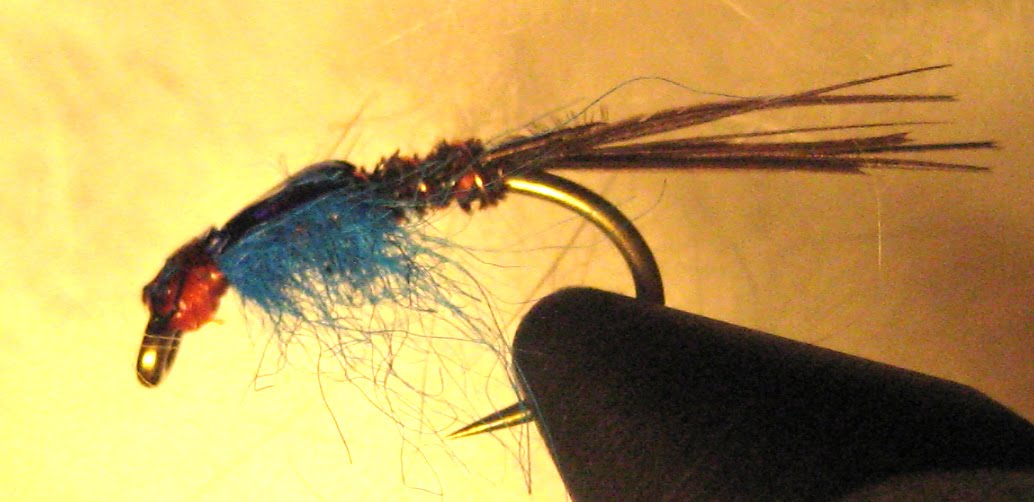
What if?  Yea, what if you had to fish for a full year with just one fly pattern in any size needed.  What would your choice be?  I would choose the Pheasant Tail.

I have caught all sorts of fish on this fly.  Trout, Atlantic Salmon and Steelhead have all taken the pattern.  There are just so many different variations possible it seems like the choices are endless.  This photo is of some size 16's with brown hackle for legs.  I tie with burnt orange 12/0 Georgio Bennechi thread.

Frank Sawyer first tied the patter to imitate Baetis found in the chalk streams of England.  This simple and drab fly was tied using only the Pheasant tail for tail, body and wing casing with peacock hurl for the abdomen.  There was no tying thread but only fine copper wire.

For Steelhead I tie the fly on a size 8 to 12 Caddis style hook and will make the abdomen of different colors.  Chartreuse, bright blue and red will all work at different times.  Also the fly can be tied as an egg sucking Pheasant Tail.  It seems egg sucking anything will do well in Pulaski.
For Atlantic Salmon I use an up eye Salmon iron with the tail a bit longer.  Any size will work just fine depending on water conditions.  The photo is a size 6 heavy iron hook.  Try dead drifting when the fish have been in the river for a while with a size 12.  A little twitch might do the trick.


Use your imagination with this fly.  It will surprise you in all the forms it can take as well as all the different kinds of fish that will bite.

Sunday, August 15, 2010

#14's A Charm

Once upon a time I traveled,  with my brother, to New Brunswick, Canada each and every October to fish the Cains River.  Some years we saw good days, but mostly the season closed before the big run of fall Salmon were on the move in earnest.

One year though, the water was perfect and the fish were moving up river in massive quantity.  We traveled on the Cains River Road over the Miramichi and covered the five miles of dirt to where it meets the Cains.  Turn left on the logging road and you will find the magical pools between Coburn's down to Finn Brook.

This day we turned right and decided to fish The School House Pool that is right on the road.  Although the fish were very active we could not get a take.  They were moving through the pool and would not stop to even take a look.  I did notice that a short distance down river there was a constant show happening on river left.  We proceeded down and in a very small amount of time my brother landed the largest salmon of both our lives.  A nice female of about twenty pounds  At that moment I was in second place and it was not a comfortable position as a bit of a contorting smirk had developed on his face.

I waded out into the top of the bar and started to cast a #10 Copper Killer that produced an immediate boil to the fly.  Second cast, nothing.  Third, nothing.  Fourth, nothing.  For the next two hours I tied on twelve other flies and cast no more than four times with each.  The fish would  show to the first cast and then nothing.  On the fourteenth fly I went back to the first fly. I cast the tiny fly and the fish struck the tiny Copper Killer and tail danced backward for what seemed like minutes.  We measured from hook jaw to tail at 44" and let him go about 100 yards below the pool.

If you are going to be Salmon fishing during September and October make sure that you have a few Copper Killers in smaller sizes.  It just might be the trick that keeps a little brother from smiling too much.

William

Tuesday, August 10, 2010

Turning Goose Liver Into Goose Pate'


You want to give this a try.  There are many different feathers that can be used in the Spey style.  In order to get a wide range of sizing and looks different feathers are needed.

Burning these feathers is easy and very cost effective.  Please watch this video and then see for yourself.

William                                                                           The Crimson Tide

Burning Spey Hackles Video

Monday, August 2, 2010

Does The Fly Really Matter?

For many Octobers, I made a trip to New Brunswick, Canada to close out the Atlantic Salmon season.  I would base myself in the Blackville area and fish the fall run rivers.  Cains, Bartholomew, Little Sou' West and the Mirimichi.

On this particular trip the fishing was hard.  The major attraction for me was to go to the Cains River and have at it's famed large fish as they ran far up river.  The water was low and the fishing was slow.  My guide's two sons, who lived in Fredericton, called to say that the Nashwaak was up and the fish were is great numbers.  We drove to meet them at the Pig Farm Pool.  This pool is one of the first bar style pools that the fish encounter on the Nashwaak.  The water makes a right hand sweep over a bar and deflects off the deeper river left.  You can fish from the bar or as we did just below the bar on river left. 

A very interesting aspect of this tributary of the Saint John is that the headwaters start on the opposite slope that creates the Mirimichi River.  Nashwaak Lake is only five miles from Mirimachi Lake.  Today, the Nashwaak is closed to Salmon fishing as it is a Bay of Fundy class river and has seen a dramatic decrease in numbers.

This was one of those magical times when you could sit on the bank and watch for the fish coming.  There were just so many.  Hold, Hold, Hoooold, OK cast away.  Chances were good that if you had the right fly you could hook, not necessarily land, a salmon from each pod.  And that is exactly what happened.  I was on fire.  The salmon Gods were with me and I proceeded to hook nine salmon in one hour and fifteen minutes.  I landed three.

The fly was a well used and trusted Mickey Finn.  I hooked and released my first salmon from the Narraguagus River in Maine many years before on a Micky Finn.  This was my favorite fall fly, period.  On one poorly executed cast I caught the brush behind me and the Mickey was gone.  I looked and looked and could not retrieve that fly.  Oh well, I opened my box and tied on another Mickey Finn.  No problem, I would land my limit number four fish and we would go home. Right???

For the next three hours I watched wave after wave of salmon proceed past me with the same rod, the same reel, the same line, the same leader and the same fly.  No takers.  The same fly?  Well not really.  Is it possible that the flies that are so successful must be copied exactly in the shape and form in order to be right?  Is a Mickey a Mickey?  Or, as some might have you believe that the fly does not matter.

Today, I carry more than one fly in each of my go to patterns.  If I am not successful with a Black Dose and I want to go back to the Black Dose later, I use a different Black Dose.  Who knows, maybe the wing is the smallest amount too long.

I do wish I had that Micky Finn back.  It might answer so many questions.  And then again...................

William