I'm back far too quickly from the long week ends trip. The colors are changing, the temperature is down and the river is just full of salmon this year. Every major holding pool has fish in the upper river. The lower pools are not doing well at all. Seems like the heat and low water of August pushed the fish that would stay in the lower pools higher up river. As the season gets closer to spawning time new fish will arrive and some will drop back to the place of their birth.
The Matapedia is a Salmon fishermen's river. Understanding the conditions takes the time to learn what the possibilities will be. In my thirty years of angling there it still can take me a little bit of time to unlock the door. This trip was no exception.
Over the past two weeks the night time thermometer has already hit 32 and the valley has had it's first frost. The river was reading 51 degrees in the morning and only making it to 55 degrees by the afternoon. The dry fly fishing I fantasized about was not going to happen. I did try but there were no takers. The smallest fly that was working only needed to be a size six. This was a bit larger than I expected. The fly of choice turned out to be the orange shrimp patterns like Alley's Shrimp, Pot Belly Pig and General Practitioners. I hooked three fish on my Orange & Black and all Orange Generals.
If you were to look at the statistics for Matapedia you would find that in a great year like this the average is 1 fish for every 4 rod days. Most years you can expect to fish for six days per salmon. Then look at the statistics and you will see that right now the average is running one salmon for every two days. Very good indeed.
The river will fish well right now through the close at the end of the month. If you have any questions on the Matapedia and surrounding area please sen me an email.
I love fly fishing. I am a Fly Fishers International Certified Single & Two Hand Casting Instructor with sixty years experience in fly fishing, casting and fly tying to share. Please feel free to send me an e-mail and I will tell you what I know. My areas of knowledge are in fly fishing and fly tying for North Eastern trout, Landlocked salmon and the experience of over forty rivers world wide fly casting to Atlantic Salmon.
Monday, September 20, 2010
Wednesday, September 15, 2010
I Love Quebec, Matapedia Bound
So right now I should be sleeping. No can do because I am finishing packing to go to Matapedia and possibly over to Matane if needed. The water is up and the river is out of this August's issues of high heat and the lowest recorded river height in history. The Matapedia turns catch and release today, the locals will be in the woods hunting and the crowds of spring and early summer are gone.
This past June and July the Matapedia had it's best start in fifty years. The fish were large and entering the river every day. Sadly, I missed being there due to work and family responsibilities. So, I am going to go for three days in September. I have had a mixed bag of September fishing in past years but what I have noticed is that when the water has been revived with rain and cool nights the fishing can be wonderful. I have had more than one three fish days in September on a number of Quebec rivers.
There are two ways to be successful. The first is to use very small wet flies. Size 8-12 tied sparsely. You make your presentation so that the fly can dangle in the current as much as possible. I then try to twitch the fly back in very short one to two inch strips. This style of salmon fishing can be very tedious and at the same time a killer for fish that have been in the river for a while.
The second and my absolute favorite way to fish Salmo Salar is dry fly. You make quick casts on short drifts. Pick up, lay down, pick up, lay down. Look at the river as it is a big piece of graph paper. Cover every one foot square from bottom to top. Make the fly pop on the water and don't be afraid to make a commotion. Most times the fish will come up and slap the fly. If this is happening stay with the same fly in smaller or larger sizes. They say in Quebec that the large bomber is for attracting the fish, the small bomber is for catching the fish.
My head is spinning, my equipment is squared away, I have all new leader material, my flies are in great condition, well sorted and arranged. Three two handers are packed and each with multiple reels and lines. I think the timing is right and I am filled with anticipation. I have been on more Salmon trips than I could ever remember and I still feel like a kid every time. Wish me luck!!!!!
This past June and July the Matapedia had it's best start in fifty years. The fish were large and entering the river every day. Sadly, I missed being there due to work and family responsibilities. So, I am going to go for three days in September. I have had a mixed bag of September fishing in past years but what I have noticed is that when the water has been revived with rain and cool nights the fishing can be wonderful. I have had more than one three fish days in September on a number of Quebec rivers.
There are two ways to be successful. The first is to use very small wet flies. Size 8-12 tied sparsely. You make your presentation so that the fly can dangle in the current as much as possible. I then try to twitch the fly back in very short one to two inch strips. This style of salmon fishing can be very tedious and at the same time a killer for fish that have been in the river for a while.
The second and my absolute favorite way to fish Salmo Salar is dry fly. You make quick casts on short drifts. Pick up, lay down, pick up, lay down. Look at the river as it is a big piece of graph paper. Cover every one foot square from bottom to top. Make the fly pop on the water and don't be afraid to make a commotion. Most times the fish will come up and slap the fly. If this is happening stay with the same fly in smaller or larger sizes. They say in Quebec that the large bomber is for attracting the fish, the small bomber is for catching the fish.
My head is spinning, my equipment is squared away, I have all new leader material, my flies are in great condition, well sorted and arranged. Three two handers are packed and each with multiple reels and lines. I think the timing is right and I am filled with anticipation. I have been on more Salmon trips than I could ever remember and I still feel like a kid every time. Wish me luck!!!!!
Friday, September 10, 2010
Heaven In October, They call It Margaree
For me the Margaree River on Cape Breton Island in Nova Scotia represents the end to my North American Atlantic Salmon season. This is not a consolation prize. The Margaree valley is so wonderful that just being there is magical. The bonus of some large chrome is the cherry on top.
There is one very important factor that must be in play to make the circle complete. A flush of water.
The river has two separate and distinctive runs each year. There is a summer run in June and July that has been on the increase over the last few years. These fish spread out over the entire river and receive steady angling pressure. They will be very dark by the time October rolls around. The fall run is made up of some very beautiful wide shoulder fish that will start to trickle during the first week of the month. It's a nice steady increase of water that is important to this time. I have seen the run hold off until later in low water years.
Some Margaree veterans say that you should wait as late as possible in October. This year I am pushing the time back three days. I have but four days to fish and want to make the best of the timing. Most years you have a choice. The second week of October will afford decent weather, sometimes down right perfect but there is a strong possibility that the fish don't show. The third week the fish seem to like but the weather can snap to a winter feel over night. I have experienced warm sun and light winds as well as snow flying sideways and the worst of conditions. A fire and hot soup is advised.
The river is all public from the Big Intervale bridge down to the sea and offers very different challenges. Make sure you drive up and see the area. I bring three two hand rods. 15'/10, 13'/7 and 10'3"switch/8. In October the rules require single hook that is barb free or pinched. I use many different sizes of flies from size 6 to SunRay size tubes. A big #2 Mickey Finn will do the trick on most pools. You will want to have the color purple in some marabou collar flies and I strongly recommend the Ross Special.
I am giving this information and advise because I have never felt crowded on the Margaree. Some of the pools can get a bit tight but there are so many places that can hold fish it is hard to cover but a few over a weeks trip. The mix of people are the best you will find anywhere. Please send me an e-mail should you desire any further information. I think about the Margaree for the full twelve months waiting for the next trip. I call it "Heaven In October"
There is one very important factor that must be in play to make the circle complete. A flush of water.
The river has two separate and distinctive runs each year. There is a summer run in June and July that has been on the increase over the last few years. These fish spread out over the entire river and receive steady angling pressure. They will be very dark by the time October rolls around. The fall run is made up of some very beautiful wide shoulder fish that will start to trickle during the first week of the month. It's a nice steady increase of water that is important to this time. I have seen the run hold off until later in low water years.
Some Margaree veterans say that you should wait as late as possible in October. This year I am pushing the time back three days. I have but four days to fish and want to make the best of the timing. Most years you have a choice. The second week of October will afford decent weather, sometimes down right perfect but there is a strong possibility that the fish don't show. The third week the fish seem to like but the weather can snap to a winter feel over night. I have experienced warm sun and light winds as well as snow flying sideways and the worst of conditions. A fire and hot soup is advised.
The river is all public from the Big Intervale bridge down to the sea and offers very different challenges. Make sure you drive up and see the area. I bring three two hand rods. 15'/10, 13'/7 and 10'3"switch/8. In October the rules require single hook that is barb free or pinched. I use many different sizes of flies from size 6 to SunRay size tubes. A big #2 Mickey Finn will do the trick on most pools. You will want to have the color purple in some marabou collar flies and I strongly recommend the Ross Special.
I am giving this information and advise because I have never felt crowded on the Margaree. Some of the pools can get a bit tight but there are so many places that can hold fish it is hard to cover but a few over a weeks trip. The mix of people are the best you will find anywhere. Please send me an e-mail should you desire any further information. I think about the Margaree for the full twelve months waiting for the next trip. I call it "Heaven In October"
Monday, September 6, 2010
What If?
What if? Yea, what if you had to fish for a full year with just one fly pattern in any size needed. What would your choice be? I would choose the Pheasant Tail.
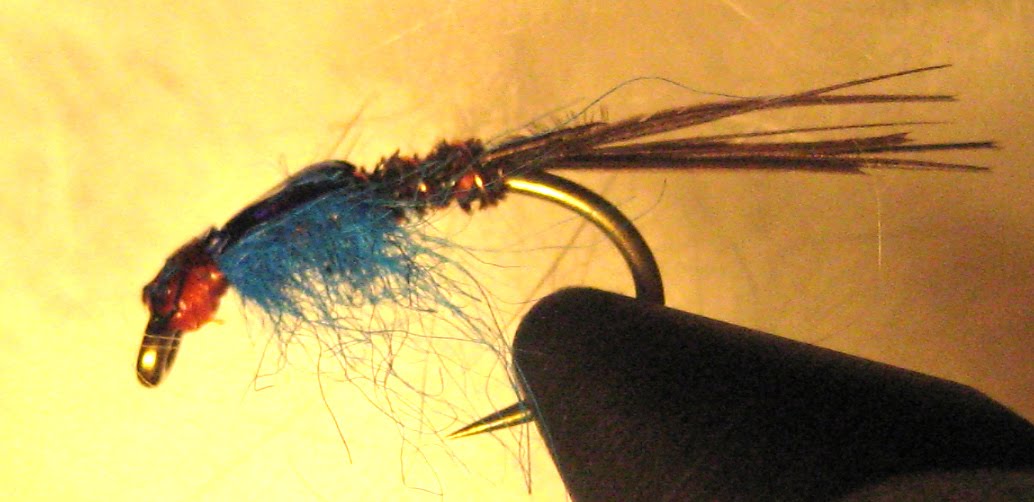
I have caught all sorts of fish on this fly. Trout, Atlantic Salmon and Steelhead have all taken the pattern. There are just so many different variations possible it seems like the choices are endless. This photo is of some size 16's with brown hackle for legs. I tie with burnt orange 12/0 Georgio Bennechi thread.
Frank Sawyer first tied the patter to imitate Baetis found in the chalk streams of England. This simple and drab fly was tied using only the Pheasant tail for tail, body and wing casing with peacock hurl for the abdomen. There was no tying thread but only fine copper wire.
For Steelhead I tie the fly on a size 8 to 12 Caddis style hook and will make the abdomen of different colors. Chartreuse, bright blue and red will all work at different times. Also the fly can be tied as an egg sucking Pheasant Tail. It seems egg sucking anything will do well in Pulaski.
For Atlantic Salmon I use an up eye Salmon iron with the tail a bit longer. Any size will work just fine depending on water conditions. The photo is a size 6 heavy iron hook. Try dead drifting when the fish have been in the river for a while with a size 12. A little twitch might do the trick.
Use your imagination with this fly. It will surprise you in all the forms it can take as well as all the different kinds of fish that will bite.
I have caught all sorts of fish on this fly. Trout, Atlantic Salmon and Steelhead have all taken the pattern. There are just so many different variations possible it seems like the choices are endless. This photo is of some size 16's with brown hackle for legs. I tie with burnt orange 12/0 Georgio Bennechi thread.
Frank Sawyer first tied the patter to imitate Baetis found in the chalk streams of England. This simple and drab fly was tied using only the Pheasant tail for tail, body and wing casing with peacock hurl for the abdomen. There was no tying thread but only fine copper wire.
For Steelhead I tie the fly on a size 8 to 12 Caddis style hook and will make the abdomen of different colors. Chartreuse, bright blue and red will all work at different times. Also the fly can be tied as an egg sucking Pheasant Tail. It seems egg sucking anything will do well in Pulaski.
For Atlantic Salmon I use an up eye Salmon iron with the tail a bit longer. Any size will work just fine depending on water conditions. The photo is a size 6 heavy iron hook. Try dead drifting when the fish have been in the river for a while with a size 12. A little twitch might do the trick.
Use your imagination with this fly. It will surprise you in all the forms it can take as well as all the different kinds of fish that will bite.
Sunday, August 15, 2010
#14's A Charm
Once upon a time I traveled, with my brother, to New Brunswick, Canada each and every October to fish the Cains River. Some years we saw good days, but mostly the season closed before the big run of fall Salmon were on the move in earnest.
One year though, the water was perfect and the fish were moving up river in massive quantity. We traveled on the Cains River Road over the Miramichi and covered the five miles of dirt to where it meets the Cains. Turn left on the logging road and you will find the magical pools between Coburn's down to Finn Brook.
This day we turned right and decided to fish The School House Pool that is right on the road. Although the fish were very active we could not get a take. They were moving through the pool and would not stop to even take a look. I did notice that a short distance down river there was a constant show happening on river left. We proceeded down and in a very small amount of time my brother landed the largest salmon of both our lives. A nice female of about twenty pounds At that moment I was in second place and it was not a comfortable position as a bit of a contorting smirk had developed on his face.
I waded out into the top of the bar and started to cast a #10 Copper Killer that produced an immediate boil to the fly. Second cast, nothing. Third, nothing. Fourth, nothing. For the next two hours I tied on twelve other flies and cast no more than four times with each. The fish would show to the first cast and then nothing. On the fourteenth fly I went back to the first fly. I cast the tiny fly and the fish struck the tiny Copper Killer and tail danced backward for what seemed like minutes. We measured from hook jaw to tail at 44" and let him go about 100 yards below the pool.
If you are going to be Salmon fishing during September and October make sure that you have a few Copper Killers in smaller sizes. It just might be the trick that keeps a little brother from smiling too much.
William
One year though, the water was perfect and the fish were moving up river in massive quantity. We traveled on the Cains River Road over the Miramichi and covered the five miles of dirt to where it meets the Cains. Turn left on the logging road and you will find the magical pools between Coburn's down to Finn Brook.
This day we turned right and decided to fish The School House Pool that is right on the road. Although the fish were very active we could not get a take. They were moving through the pool and would not stop to even take a look. I did notice that a short distance down river there was a constant show happening on river left. We proceeded down and in a very small amount of time my brother landed the largest salmon of both our lives. A nice female of about twenty pounds At that moment I was in second place and it was not a comfortable position as a bit of a contorting smirk had developed on his face.
I waded out into the top of the bar and started to cast a #10 Copper Killer that produced an immediate boil to the fly. Second cast, nothing. Third, nothing. Fourth, nothing. For the next two hours I tied on twelve other flies and cast no more than four times with each. The fish would show to the first cast and then nothing. On the fourteenth fly I went back to the first fly. I cast the tiny fly and the fish struck the tiny Copper Killer and tail danced backward for what seemed like minutes. We measured from hook jaw to tail at 44" and let him go about 100 yards below the pool.
If you are going to be Salmon fishing during September and October make sure that you have a few Copper Killers in smaller sizes. It just might be the trick that keeps a little brother from smiling too much.
William
Tuesday, August 10, 2010
Turning Goose Liver Into Goose Pate'
You want to give this a try. There are many different feathers that can be used in the Spey style. In order to get a wide range of sizing and looks different feathers are needed.
Burning these feathers is easy and very cost effective. Please watch this video and then see for yourself.
William The Crimson Tide
Burning Spey Hackles Video
Monday, August 2, 2010
Does The Fly Really Matter?
For many Octobers, I made a trip to New Brunswick, Canada to close out the Atlantic Salmon season. I would base myself in the Blackville area and fish the fall run rivers. Cains, Bartholomew, Little Sou' West and the Mirimichi.
On this particular trip the fishing was hard. The major attraction for me was to go to the Cains River and have at it's famed large fish as they ran far up river. The water was low and the fishing was slow. My guide's two sons, who lived in Fredericton, called to say that the Nashwaak was up and the fish were is great numbers. We drove to meet them at the Pig Farm Pool. This pool is one of the first bar style pools that the fish encounter on the Nashwaak. The water makes a right hand sweep over a bar and deflects off the deeper river left. You can fish from the bar or as we did just below the bar on river left.
A very interesting aspect of this tributary of the Saint John is that the headwaters start on the opposite slope that creates the Mirimichi River. Nashwaak Lake is only five miles from Mirimachi Lake. Today, the Nashwaak is closed to Salmon fishing as it is a Bay of Fundy class river and has seen a dramatic decrease in numbers.
This was one of those magical times when you could sit on the bank and watch for the fish coming. There were just so many. Hold, Hold, Hoooold, OK cast away. Chances were good that if you had the right fly you could hook, not necessarily land, a salmon from each pod. And that is exactly what happened. I was on fire. The salmon Gods were with me and I proceeded to hook nine salmon in one hour and fifteen minutes. I landed three.
The fly was a well used and trusted Mickey Finn. I hooked and released my first salmon from the Narraguagus River in Maine many years before on a Micky Finn. This was my favorite fall fly, period. On one poorly executed cast I caught the brush behind me and the Mickey was gone. I looked and looked and could not retrieve that fly. Oh well, I opened my box and tied on another Mickey Finn. No problem, I would land my limit number four fish and we would go home. Right???
For the next three hours I watched wave after wave of salmon proceed past me with the same rod, the same reel, the same line, the same leader and the same fly. No takers. The same fly? Well not really. Is it possible that the flies that are so successful must be copied exactly in the shape and form in order to be right? Is a Mickey a Mickey? Or, as some might have you believe that the fly does not matter.
Today, I carry more than one fly in each of my go to patterns. If I am not successful with a Black Dose and I want to go back to the Black Dose later, I use a different Black Dose. Who knows, maybe the wing is the smallest amount too long.
I do wish I had that Micky Finn back. It might answer so many questions. And then again...................
William
On this particular trip the fishing was hard. The major attraction for me was to go to the Cains River and have at it's famed large fish as they ran far up river. The water was low and the fishing was slow. My guide's two sons, who lived in Fredericton, called to say that the Nashwaak was up and the fish were is great numbers. We drove to meet them at the Pig Farm Pool. This pool is one of the first bar style pools that the fish encounter on the Nashwaak. The water makes a right hand sweep over a bar and deflects off the deeper river left. You can fish from the bar or as we did just below the bar on river left.
A very interesting aspect of this tributary of the Saint John is that the headwaters start on the opposite slope that creates the Mirimichi River. Nashwaak Lake is only five miles from Mirimachi Lake. Today, the Nashwaak is closed to Salmon fishing as it is a Bay of Fundy class river and has seen a dramatic decrease in numbers.
This was one of those magical times when you could sit on the bank and watch for the fish coming. There were just so many. Hold, Hold, Hoooold, OK cast away. Chances were good that if you had the right fly you could hook, not necessarily land, a salmon from each pod. And that is exactly what happened. I was on fire. The salmon Gods were with me and I proceeded to hook nine salmon in one hour and fifteen minutes. I landed three.
The fly was a well used and trusted Mickey Finn. I hooked and released my first salmon from the Narraguagus River in Maine many years before on a Micky Finn. This was my favorite fall fly, period. On one poorly executed cast I caught the brush behind me and the Mickey was gone. I looked and looked and could not retrieve that fly. Oh well, I opened my box and tied on another Mickey Finn. No problem, I would land my limit number four fish and we would go home. Right???
For the next three hours I watched wave after wave of salmon proceed past me with the same rod, the same reel, the same line, the same leader and the same fly. No takers. The same fly? Well not really. Is it possible that the flies that are so successful must be copied exactly in the shape and form in order to be right? Is a Mickey a Mickey? Or, as some might have you believe that the fly does not matter.
Today, I carry more than one fly in each of my go to patterns. If I am not successful with a Black Dose and I want to go back to the Black Dose later, I use a different Black Dose. Who knows, maybe the wing is the smallest amount too long.
I do wish I had that Micky Finn back. It might answer so many questions. And then again...................
William
Tuesday, July 27, 2010
Syd Glasso Orange Heron
It is very rare for a completely new fly form to be credited to just one person. But in the case of Syd Glasso it is exactly what happened. Syd Glasso shared his Steelhead Spey style flies and the use of Saddle tips as Spey wings was born.
Although there seems to be no exacting list of patterns, as Mr. Glasso tied many variations of his flies, there are a number of patterns that are well known and in common use today.
A few are Black, Purple, Gold, Orange and Silver Heron. Sol Duc, Sol Duc Dark and Sol Duc Spey. Any steelhead river will be very honored to be fished with the work of Syd Glasso. I just think it is a great deal of fun and will be some of my go to flies in New York this November.
Orange Heron (in my variation)
Alex Jackson Gold 3.0
Orange Floss Rear Body
Gold Tag & Rib
Orange Dubbing Front Body
Natural Blue Eared Pheasant from Floss Forward
Teal Collar Pulled Down
Four Orange Saddle Hackle Tips Wing
Red Head With Four Coats Clear
Tuesday, June 29, 2010
Four Days On Glen Emma
At 7:45 on the morning of June 25, 2006, I arrived at the Glenn Emma Camp on the Matapedia River on the Gaspe Peninsula of Quebec. I drew #54 in the November lottery and picked the four days allowed. During my first visit to the Matapedia in 1980 I had the great fortune to get that certain feeling of the valley. There was something that called me back year after year, and now I understand why.
At 9:15 I had been through Angus Pool and already raised six fish, hooked two and landed a fifteen pound rocket. The one that got away Tarponed out of the tail of the pool, jump after jump straight down through the rapid below, deep into my backing and then my line went limp. This was the best hour and fifteen minutes of Salar I had experienced in many years. My memory of that morning is stitched to my forehead as if I can see through a third eye.
The rotation rules at Glenn Emma are a wee bit complicated to understand at first. You can be in line for the best or something not quite the best. I hit the jackpot.
Glenn Emma fishes ten pools per session with one rod per pool. If you land a fish in the morning session, you can not fish that pool for the evening and must move in a set rotation. A bit upset, yet not complaining, I was moved to sector 5 for the evening hours. My mind was on what I lost and not what I could gain. During the afternoon the sport in Milnikek Pool, the greatest of all pools on the river, made his limit. Now the person in sector 4 was called on the walkie talkie to move on down to Milnikek. As that angler made his final catch at 7:30, I could now move down into the famed waters. I landed my second and limit fish for the day after about 10 casts. A dime bright twelve pound fish. Now I get it, and I full well expected what was to come.
On day two my natural rotation was to sector 4, as I did not hook a fish there the day before. The highlight of this zone, is a great pool called Elm Tree. Spectacular ledge water with deep pockets and runs. We saw only one fish and could not get it to take. Again there was the calling of the radio in a French machine gun like voice, Milnikek, Milnikek, Milnikek is open. We slid on down.
That afternoon in this incredible water I raised more salmon than I had in the last ten years. I have fished on some of the best waters of the Gaspe, but nothing has been as magical as the waters set before me for these few days. By 8pm I was at my three fish limit with a bright beauty of 20+ pounds. We released her from the grip of a size 6 hybrid Black Dose. I slept well.
The next morning my natural rotation placed me in, yes that's right, Milnikek Pool. The weather was very different that day and the barometer was keeping the fish down. I had my chances to dries and wets all morning without a hook up. The rain fell hard and muddied the waters up stream out of the Causapscal, the Matapedia's main tributary and home to the largest fish the system holds.
The second half to the day found the river settled and clear yet started very slowly. Not until my trusted guide Guy Raymond said “the black dose" at exactly 8pm. Polling into expert position and pointing to the exact location of experience Guy said, "right there". One cast into the slick where Milnikek Stream enters the pool and we were fast to the largest fish of the trip. Twenty minutes of fight and we released a 25 pound beauty.
My fourth and final day was on a pool called Kennedy. Natural rotation, got it now. A very long pool with different aspects of fast and slow water top to bottom. I managed to raise a few fish as well as bungle a take to an orange bomber. This was a no emergency day with little pressure. A day I simply enjoyed the fishing and the memories of the six fish that came before. I also wonder if my luck, possibly exhausted, will ever call me back to Milnikek. Make sure you get your November 1 draw tickets for Glenn Emma. I don't think the chances are very good to get three days on Milnikek but I would be happy for just one on Angus.
Right now the Matapedia is dancing in my head. This is a Salmon fishers Salmon river at it's best and should be on every one's bucket list. Go now!!!! The run is on.
William
At 9:15 I had been through Angus Pool and already raised six fish, hooked two and landed a fifteen pound rocket. The one that got away Tarponed out of the tail of the pool, jump after jump straight down through the rapid below, deep into my backing and then my line went limp. This was the best hour and fifteen minutes of Salar I had experienced in many years. My memory of that morning is stitched to my forehead as if I can see through a third eye.
The rotation rules at Glenn Emma are a wee bit complicated to understand at first. You can be in line for the best or something not quite the best. I hit the jackpot.
Glenn Emma fishes ten pools per session with one rod per pool. If you land a fish in the morning session, you can not fish that pool for the evening and must move in a set rotation. A bit upset, yet not complaining, I was moved to sector 5 for the evening hours. My mind was on what I lost and not what I could gain. During the afternoon the sport in Milnikek Pool, the greatest of all pools on the river, made his limit. Now the person in sector 4 was called on the walkie talkie to move on down to Milnikek. As that angler made his final catch at 7:30, I could now move down into the famed waters. I landed my second and limit fish for the day after about 10 casts. A dime bright twelve pound fish. Now I get it, and I full well expected what was to come.
On day two my natural rotation was to sector 4, as I did not hook a fish there the day before. The highlight of this zone, is a great pool called Elm Tree. Spectacular ledge water with deep pockets and runs. We saw only one fish and could not get it to take. Again there was the calling of the radio in a French machine gun like voice, Milnikek, Milnikek, Milnikek is open. We slid on down.
That afternoon in this incredible water I raised more salmon than I had in the last ten years. I have fished on some of the best waters of the Gaspe, but nothing has been as magical as the waters set before me for these few days. By 8pm I was at my three fish limit with a bright beauty of 20+ pounds. We released her from the grip of a size 6 hybrid Black Dose. I slept well.
The next morning my natural rotation placed me in, yes that's right, Milnikek Pool. The weather was very different that day and the barometer was keeping the fish down. I had my chances to dries and wets all morning without a hook up. The rain fell hard and muddied the waters up stream out of the Causapscal, the Matapedia's main tributary and home to the largest fish the system holds.
The second half to the day found the river settled and clear yet started very slowly. Not until my trusted guide Guy Raymond said “the black dose" at exactly 8pm. Polling into expert position and pointing to the exact location of experience Guy said, "right there". One cast into the slick where Milnikek Stream enters the pool and we were fast to the largest fish of the trip. Twenty minutes of fight and we released a 25 pound beauty.
My fourth and final day was on a pool called Kennedy. Natural rotation, got it now. A very long pool with different aspects of fast and slow water top to bottom. I managed to raise a few fish as well as bungle a take to an orange bomber. This was a no emergency day with little pressure. A day I simply enjoyed the fishing and the memories of the six fish that came before. I also wonder if my luck, possibly exhausted, will ever call me back to Milnikek. Make sure you get your November 1 draw tickets for Glenn Emma. I don't think the chances are very good to get three days on Milnikek but I would be happy for just one on Angus.
Right now the Matapedia is dancing in my head. This is a Salmon fishers Salmon river at it's best and should be on every one's bucket list. Go now!!!! The run is on.
William
Sunday, June 13, 2010
Hat's Off On North Conway's Saco River
The Saco River should be a destination for any angler who wants to have a complete New England fly casting experience. My first visit was in the summer of 1973. It's really simple. This is New Hampshire's Beverkill, Battenkill and Ausable in the minds eye of a fly casters dream. The beginnings of fly fishing in New England can be felt by those who what to experience the lore of the river. She flows crystal from the Presidential Mountain Range for some 134 miles to enter the Atlantic at Saco, Maine.
I saw many very large browns cruising one of the pools I fished. Some locations had only brook trout in the ten inch range but what they lack in size is made up in quantity. They traveled in packs. Yesterday was a very hard fishing day as the barometric pressure and higher than desired flow made for a hatch free day. To say activity was low would be an understatement. The highlight for this time of year is the spinner fall late in the day. No hatch means no spinners. I did manage three good browns and five brookies all on Light Cahill Wood Duck Emergers. They had to be twitched and slowly stripped just under the surface.
You can walk the entire two and a half miles of the fly fishing controlled section to see all pools. The land is private and locals ask for our civil awareness to keep the area clean. The area is shadowed by the White Mountains and has the look and feel of the great outdoors at it's best.
By itself, New Hampshire does a fine job with stocking the river as the indigenous brook trout can not compete with angling pressure. The added bonus is the tradition and understanding in North Conway that the health of the river, as a fishing and canoeing waterway, is vital. The state gives permission for a controlled stocking in addition to it's investment.
Bill Thompson, the owner of North Country Anglers writes, "In what has become an annual rite of spring the members of Saco Valley Anglers Trout Unlimited have once again stocked the Saco River with trout. Saco Valley Anglers have been doing this for over twenty-five years. The annual event came about do to the efforts of two of the founding members of the trout club Dick Surette and Dick Stewart. Dick Surette was always fond of saying: “Most clubs stock trout in private ponds for the exclusive use of their members, our club puts trout in public water so that anyone may fish for them”. The stocked fish are in addition to the trout stocked by the New Hampshire Fish and Game Department. The trout are paid for by funds raised by club members at their annual auction."
If you are fishing Saco for the first time, I suggest you hire a guide. You can also make part of the day going to the Ellis River for some quality rainbow fishing. If you want the best of the fishing, you will not want to spend your time searching.
The one thing that is hard to deal with is the canoe and kayak hatch. This river is more heavily traveled as we get closer to July especially on week ends . If you want to go, go now!
William
If you want to know more about the Saco then please Email me at flyspoke@gmail.com
I saw many very large browns cruising one of the pools I fished. Some locations had only brook trout in the ten inch range but what they lack in size is made up in quantity. They traveled in packs. Yesterday was a very hard fishing day as the barometric pressure and higher than desired flow made for a hatch free day. To say activity was low would be an understatement. The highlight for this time of year is the spinner fall late in the day. No hatch means no spinners. I did manage three good browns and five brookies all on Light Cahill Wood Duck Emergers. They had to be twitched and slowly stripped just under the surface.
You can walk the entire two and a half miles of the fly fishing controlled section to see all pools. The land is private and locals ask for our civil awareness to keep the area clean. The area is shadowed by the White Mountains and has the look and feel of the great outdoors at it's best.
By itself, New Hampshire does a fine job with stocking the river as the indigenous brook trout can not compete with angling pressure. The added bonus is the tradition and understanding in North Conway that the health of the river, as a fishing and canoeing waterway, is vital. The state gives permission for a controlled stocking in addition to it's investment.
Bill Thompson, the owner of North Country Anglers writes, "In what has become an annual rite of spring the members of Saco Valley Anglers Trout Unlimited have once again stocked the Saco River with trout. Saco Valley Anglers have been doing this for over twenty-five years. The annual event came about do to the efforts of two of the founding members of the trout club Dick Surette and Dick Stewart. Dick Surette was always fond of saying: “Most clubs stock trout in private ponds for the exclusive use of their members, our club puts trout in public water so that anyone may fish for them”. The stocked fish are in addition to the trout stocked by the New Hampshire Fish and Game Department. The trout are paid for by funds raised by club members at their annual auction."
If you are fishing Saco for the first time, I suggest you hire a guide. You can also make part of the day going to the Ellis River for some quality rainbow fishing. If you want the best of the fishing, you will not want to spend your time searching.
The one thing that is hard to deal with is the canoe and kayak hatch. This river is more heavily traveled as we get closer to July especially on week ends . If you want to go, go now!
William
If you want to know more about the Saco then please Email me at flyspoke@gmail.com
Sunday, June 6, 2010
Let It Rain, Dear Lord, Let It Rain
Yesterday, I made the trip to a favorite river in central New Hampshire. This being my fourth attempt this year, I arrived to find the river was not stocked and looking as low as I have ever seen in early June. Every place I go the water is seriously down and very warm and feels like the middle of July. I changed location and did manage a reasonable day releasing 15 rainbows from the Pemigewasset. All stocked fish and straight from the hatchery right down the road that fell for olive leaches and wood duck flies.
The Pemi is the main flow that feeds into the Merrimack River. Early in it's history the Pemi was a thriving Atlantic Salmon run. I sometimes catch myself feeling sorry for not having the opportunity to have been there then. Salmon and Shad traveled the Merrimack to Franklin where the Winnipesaukee River enters. At this point all the Shad went up the Winni and all the salmon continued up the Pemi. With the headwaters high up in the White Mountains, the river flows through some of the most rugged land New Hampshire has to offer. The area I fish, in Bristol, is boulder laden and not the easiest to navigate. This is also the home of the state record rainbow at 14 pounds.
Right now, without wanting to travel into the North Country or North Woods your best bet for trout is on the Pemigewasset. This vast area will hold many anglers and does have a substantial quantity of fish. Native and stocked Brook Trout as well as stocked rainbows are available. Who knows, you may even hook into that eighteen pound Atlantic Salmon broodstock that was put in this spring.
So back to the rain. Hopefully today we are seeing a bit of a change in the weather. The rain is falling hard right now and the temperatures look like they will be lower for the next week. We need to have some substantial precipitation in order to get things back to normal for the season.
William
The Pemi is the main flow that feeds into the Merrimack River. Early in it's history the Pemi was a thriving Atlantic Salmon run. I sometimes catch myself feeling sorry for not having the opportunity to have been there then. Salmon and Shad traveled the Merrimack to Franklin where the Winnipesaukee River enters. At this point all the Shad went up the Winni and all the salmon continued up the Pemi. With the headwaters high up in the White Mountains, the river flows through some of the most rugged land New Hampshire has to offer. The area I fish, in Bristol, is boulder laden and not the easiest to navigate. This is also the home of the state record rainbow at 14 pounds.
Right now, without wanting to travel into the North Country or North Woods your best bet for trout is on the Pemigewasset. This vast area will hold many anglers and does have a substantial quantity of fish. Native and stocked Brook Trout as well as stocked rainbows are available. Who knows, you may even hook into that eighteen pound Atlantic Salmon broodstock that was put in this spring.
So back to the rain. Hopefully today we are seeing a bit of a change in the weather. The rain is falling hard right now and the temperatures look like they will be lower for the next week. We need to have some substantial precipitation in order to get things back to normal for the season.
William
Saturday, May 29, 2010
Spey Fly?
There are big differences between the Traditional Spey Fly and the modern flies that are being tied today with long hackles. From Steelhead to Atlantic Salmon fishing the use of long rods and flies with long hackles are being called 'Spey' like it is as generic as facial tissue.
In my opinion, to call this wonderful style of flies using more modern materials and more diverse hackles Spey flies, limits the true creative flair that has been implemented on our side of the pond. Don't get me wrong, Spey, Dee, Don and British Feather Wings are wonderful examples of the style of that day. As the Northern European casters move to tubes in Temple Dog and Sun Ray style, we for sure will follow suit. I just think that today we should call this style of flies our own. I call them North American Collar Flies.
Thursday, May 27, 2010
A Sad Truth About Climate Change
Dear Friends,
Yesterday, on a fishing forum, I had a very difficult encounter over my position on Climate Change and the relationship to fishing. I did my best to not be political. The responses that were posted on the forum became increasingly so. Even though many members posted real statistics in volume they were discarded by some.
How do we confront the most important issue for the future of our country and planet without the conversation turning political? Why can't we have a lucid conversation that culminates in an intelligent conclusion and course of action?
Is Global Warming and Climate Change real? I personally think so. Should we do anything about it? I think that we have a duty to God and Country to do so?
I posted this chart as what I see as courses of action as I do not see middle ground on this topic. You ether want to do something or you don't.
What was replied from one member was a rash of information about treating people as morons by using fear as a motive.
I did nothing of the sort. I truly do not see any alternatives to these positions. The poster did not offer a fifth option. Just rants about taxes, hunger the death penalty and Al Gores private jets.
I know that talking about this topic has ramifications that may have some of you tune me out. If you do then it is my opinion that you are making a political choice and not basing your action on data. I don't believe that Climate Change is happening or not based on what the talking heads have to say. I base it on the last fifty years of charted statistics. I also believe that the situation can move in the other direction with one good volcano.
In the forum discussion some wanted to tune out. Please don't. My position is that we must all try to civilly work together on this problem. "Divided We Fall" The little things can mean so much in total. Water filters rather than plastic bottles, reusable shopping bags and not paper or plastic, making your next auto purchase have better mileage, supporting higher fuel standards, supporting reusable energy companies, the list goes on.
So how does this relate to a fishing blog?
Water, air, climate and the desire to keep them safe for generations to come. I am not trying to offend anyone or pick sides in an election but given the events in the Gulf Of Mexico over the past month, Drill Baby Drill is not high on my list of solutions to better fishing.
William
Yesterday, on a fishing forum, I had a very difficult encounter over my position on Climate Change and the relationship to fishing. I did my best to not be political. The responses that were posted on the forum became increasingly so. Even though many members posted real statistics in volume they were discarded by some.
How do we confront the most important issue for the future of our country and planet without the conversation turning political? Why can't we have a lucid conversation that culminates in an intelligent conclusion and course of action?
Is Global Warming and Climate Change real? I personally think so. Should we do anything about it? I think that we have a duty to God and Country to do so?
I posted this chart as what I see as courses of action as I do not see middle ground on this topic. You ether want to do something or you don't.
What was replied from one member was a rash of information about treating people as morons by using fear as a motive.
I did nothing of the sort. I truly do not see any alternatives to these positions. The poster did not offer a fifth option. Just rants about taxes, hunger the death penalty and Al Gores private jets.
I know that talking about this topic has ramifications that may have some of you tune me out. If you do then it is my opinion that you are making a political choice and not basing your action on data. I don't believe that Climate Change is happening or not based on what the talking heads have to say. I base it on the last fifty years of charted statistics. I also believe that the situation can move in the other direction with one good volcano.
In the forum discussion some wanted to tune out. Please don't. My position is that we must all try to civilly work together on this problem. "Divided We Fall" The little things can mean so much in total. Water filters rather than plastic bottles, reusable shopping bags and not paper or plastic, making your next auto purchase have better mileage, supporting higher fuel standards, supporting reusable energy companies, the list goes on.
So how does this relate to a fishing blog?
Water, air, climate and the desire to keep them safe for generations to come. I am not trying to offend anyone or pick sides in an election but given the events in the Gulf Of Mexico over the past month, Drill Baby Drill is not high on my list of solutions to better fishing.
William
Tuesday, May 25, 2010
Fly Tying Tip 103
When using floss always make sure that you match the effect desired with a twist. If you use floss loosely spun it will apply very flat. When wrapping from head to tag and back make sure that the wrap at the tag is twisted tighter and then made loose to go back to the head. This will give a flat body and not have your floss fall off the end when fishing.
Monday, May 17, 2010
Can Lightning Strike Twice??????
On Friday night I received a phone call from one of my good Fish Club friends. He told me that he just experienced some of the best dry fly action and I should get there on Saturday. Having great respect for this gentleman I made my way to the river.
Now what you must know is that the fish were all Landlocked Salmon ranging from eighteen to twenty two inches. Five in total over the span of two hours. Even the most avid of salmon anglers may never have such an opportunity and at the location the possibility only happens some years. The door stays open for a very, very short time and can slam shut in a heartbeat..
Saturday started out very slow I was thinking that I missed it and traveled to another location to find some fish.. I called my friend and he said that the window was connected to a hatch cadence for the Caddis that were the attraction to the salmon. He said that he did not get to the river until 3pm the day before and he would meet me there at that time. Hatches of all kinds have a rhythm.
When I arrived back at the location I found the fish boiling on caddis all over the place. I landed a nineteen inch fish on my first presentation. For three hours we both released nine fish each and missed many more. All on dry flies. The most exciting dry fly action I have ever experienced.
On the ride home I called my fishing buddy and told him of the event. He said that he has been waiting five years for this situation to happen again and would join me the next day. Because the weather was going to be sunnier and warmer we decided to get there a bit earlier and arrive at the river at 1PM. The fish were happening even more intense than the day before. I missed a fish and my friend landed a twenty inch beauty and then the whole thing shut down. It seems that the hatch happened even earlier than anticipated. We stayed until 7PM and the hatch never came back.
Wow!!! What a difference a day can make.
Rule Of The Game
Get there early and wait it out and do not give up. You may never get a chance at such wealth again.
William
If you would like more information on this post please E-mail FlySpoke@gmail.com
If you would like to post a comment please click the title
Now what you must know is that the fish were all Landlocked Salmon ranging from eighteen to twenty two inches. Five in total over the span of two hours. Even the most avid of salmon anglers may never have such an opportunity and at the location the possibility only happens some years. The door stays open for a very, very short time and can slam shut in a heartbeat..
Saturday started out very slow I was thinking that I missed it and traveled to another location to find some fish.. I called my friend and he said that the window was connected to a hatch cadence for the Caddis that were the attraction to the salmon. He said that he did not get to the river until 3pm the day before and he would meet me there at that time. Hatches of all kinds have a rhythm.
When I arrived back at the location I found the fish boiling on caddis all over the place. I landed a nineteen inch fish on my first presentation. For three hours we both released nine fish each and missed many more. All on dry flies. The most exciting dry fly action I have ever experienced.
On the ride home I called my fishing buddy and told him of the event. He said that he has been waiting five years for this situation to happen again and would join me the next day. Because the weather was going to be sunnier and warmer we decided to get there a bit earlier and arrive at the river at 1PM. The fish were happening even more intense than the day before. I missed a fish and my friend landed a twenty inch beauty and then the whole thing shut down. It seems that the hatch happened even earlier than anticipated. We stayed until 7PM and the hatch never came back.
Wow!!! What a difference a day can make.
Rule Of The Game
Get there early and wait it out and do not give up. You may never get a chance at such wealth again.
William
If you would like more information on this post please E-mail FlySpoke@gmail.com
If you would like to post a comment please click the title
Sunday, May 9, 2010
Two Hand Salter Style

If you have been in the two hand casting game for at least five years then you have seen a dramatic increase in the old world styles popularity. A re-birth of what was the norm many years ago. The benefits of Spey, Skagit and Scandi for Salmon and Steelhead have been written about for some time now. There is one aspect of the two hand rod that has not received a great deal of attention. Salt water casting from a non platform position with the use of a striping basket. Let's define what I am talking about.
Say you are fishing from the beach, rocks, flats or jetty. This means that the environment at your feet is probably not very friendly. In theory the advantage of the longer rod will be of relevance when you are able to cast farther using big flies. Having the extra length of rod should keep you clear above debris and rolling waves to achieve this goal. With the techniques below you will be casting farther and have greater control of each presentation.
One of the strongest casts that can be made with a two hand rod is with dominant hand up and over the opposite shoulder. The style is used by Scandinavian casters with shooting heads to gain great distance. This cast makes it possible to fish the salt with a two hand rod and not have your lower hand interfere with the need for a striping basket. The basket will be worn on the same side hip as your lower hand. You will also note that this keeps the bottom of the handle on your dominant hand side and does not hinder striping line.
For Wind Behind,Right To Left or Head On
- Right hand up over left shoulder = Right foot forward
- Body canters fore and aft with cast motion
- Right hand up = Stripping Basket on Left Hip
- Shooting with intermediate and sinking heads will cast best
- Use 11' to 14' firmer fast action style rods that are as light as possible with short bottom hand grips
- Back casts are made by pointing the rod tip at 10 o'clock and pulling up and back to 2 o'clock hard
- Forward cast is stopped abruptly at 11 o'clock keeping hands close to the body and making a strong pulling with the bottom hand
- Arms must be kept tight to the body with very little extension of the dominate hand
- Sling Cast holding dominate hand at shoulder level
- Lower hand at chest level
- Pull hard with lower hand
- Rock back and forward and use body momentum
- Forward Cast is stopped abruptly at 11 o'clock at horizon
- Keep arms as compact and tight to the body as possible
William
For more information about this post please email me at flyspoke@gmail.com If you would like to comment on this post please click on the time stamp.
Subscribe to:
Posts (Atom)